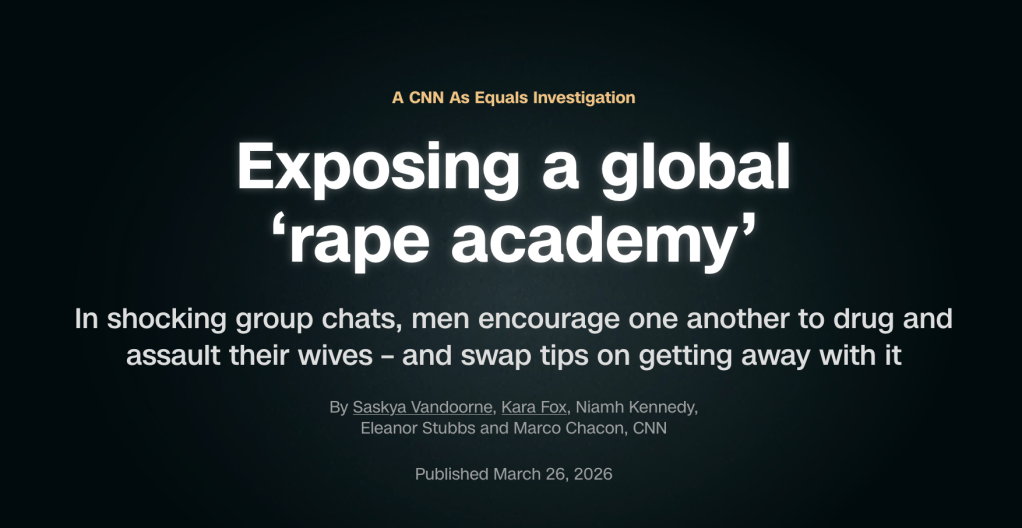
Over the weekend the story of an “online rape academy” went viral on social media, following an investigative reporting by CNN about an online network of men that exchanges tips to drug and rape their partners. The article was lengthy and detailed, and somewhere in the copy, remix and transform process of the online news cycle, details of the story got distorted and mischaracterized. A networked discussion ensued on the importance of accuracy in sharing such stories and led to outrage by some who experienced this as a call for purity. This discourse surfaces a common tension on social media between accuracy and activist intentions. In this piece I reflect on this tension, and provide insights on how those accuracy conflicts are shaped by platform mediated in-group out-group dynamics.
First the facts: on 26th March 2026 CNN reporters published a reporting titled ‘Exposing a global ‘rape academy’’ as part of its ‘As Equals’ investigation on gender inequality. Mid April, many social media content creators started sharing the report, of which many started claiming 62 million men were participating in an ‘online rape academy’.
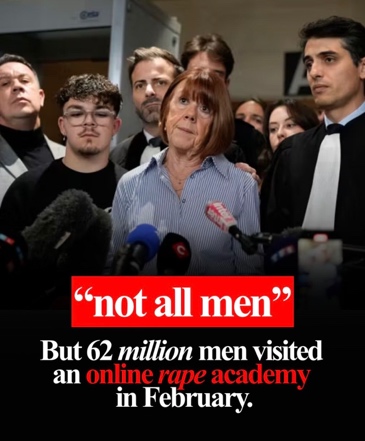
(this image was circulated widely on Twitter and Instagram)
Some corrections ensued, saying there were “only” 62 million visits to the rape academy, not 62 million men, which led to outrage with other netizens.
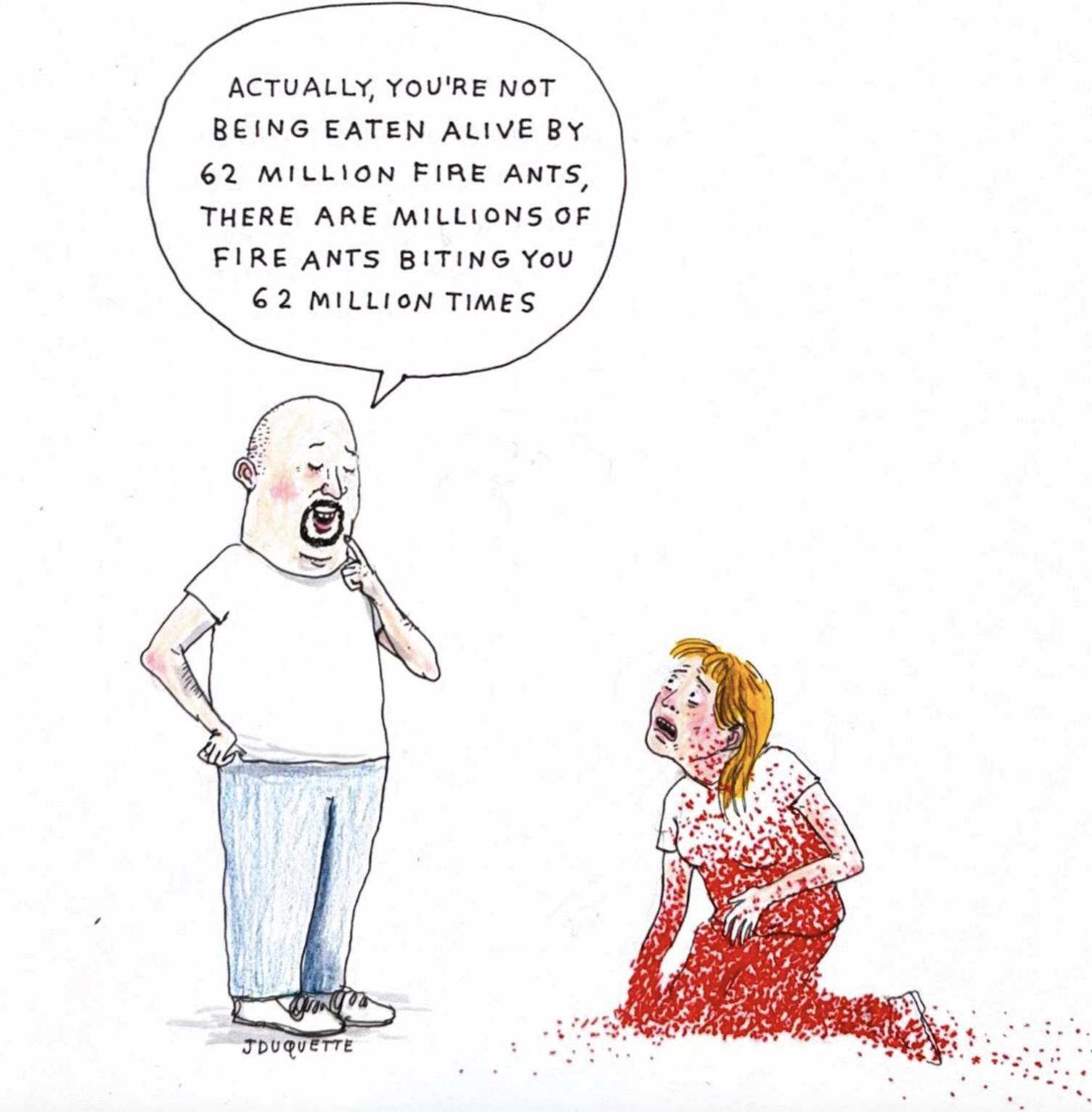
(comic by @mrJesseDuquette)
But this still did not accurate reflect the report, as there were no 62 million visitors to some “online rape academy”. In the CNN article, the “academy” term is used to describe a Telegram chatgroup with a few thousand members where users exchange tips to drug and rape their partner. The 62 million number refers to the amount of visits to the Motherless website, a porn site that hosts some of the #sleep and #eyecheck content that this online network posted on, but the website has a lot of other pornography categories that can be found on regular porn websites.
Righteous outrage
It is possible that the secondary sources skewing the number in the reporting didn’t properly read the article, or that they willfully inflated it to generate more clicks. It is also possible they didn’t think the number was important to factcheck before spreading it or be nuanced about. The Telegram group CNN found is just one of many that keep being discovered, where men exchange advice to rape women or share non-consensual sexual images. Dominique Pelicot’s group, the man who let his wife Gisele Pelicot be raped by 70+ men, is one of the most notorious ones and sparked international interest in the existence of such networks.
Furthermore, the Motherless website is not an innocent porn platform. It claims to be a ‘moral free file host where anything legal is hosted forever’, and many victims of revenge porn have found it near impossible to get content removed on the platform. As the New Feminist reports, the site also has a ton of women-degrading content and thousands of videos living under tags that show the sexual acts were likely non-consensual. Furthermore, the New Feminist shows that its architectures allow men who share similar (disturbing) preferences to find each other and move to encrypted channels like Telegram, making the porn site more of a ‘shop window’ leading people into darker backrooms.
The pushback against internet users correcting this 62million men number is therefore not difficult to comprehend. Discourse that pivots from sexual violence against women to accuracy of numbers can take attention away from the very real issues at hand. The way our algorithmized online ecosystems functions is that conflict breeds virality, which means a correction can become more visible than the actual content that is being corrected. This indignation over inaccuracy can inadvertently overshadow the indignation over the fact that there are many men worldwide exchanging tips on raping women and getting away with it.
The accuracy-activism tension
I learned the importance of not disrupting activist efforts with a factcheck for the first time when I used my Instagram account to factcheck a rumor in 2022 that 15.000 protesters in Iran were getting sentenced to death because of the Women, Life, Freedom protests. In reality ‘only’ 5 protesters had been sentenced to death and 15.000 protesters had been arrested, and called upon by some members of the Iranian parliament to be executed. I thought it was important to help factcheck this rumor, but Iranian activists made me aware that this factcheck is not at all helping the movement, as it is seeding doubts over the atrocities the regime is committing (which only escalated further, as in January 2026 estimations speculate up to 20.000 Iranian protesters were murdered by the regime in the span of a few days). What good does it do to demand factual purity from protester who are faced with a violent regime?
It made me reflect on what I was actually contributing to these activist movements by wagging the finger to keep things as factual as possible.
Despite these experiences, I still believe accuracy and factuality remain very important. Letting the importance of truthfulness fade is a slippery slope. This in turn can be weaponized by actors whose best interest is to not need to provide evidence for their claims. This happens often with far-right actors who inflate statistics on for example immigrant crime.
Even the skewed numbers of the ‘rape academy’ can be wielded by actors to seed moral panic over the dangers of the internet in their efforts to limit and control access to the internet. Efforts that disproportionately affect Sex Workers who are the first to get censored. There is of course a wider conversation to be had about the responsibilities of such porn platforms and messaging apps like Telegram that I will not get into for this piece (I wrote about it here before ) but certain efforts to mitigate these threats are worrisome for the future existence of a free and open web, and I refer to the work of Taylor Lorenz and Mike Masnick to know more why legal proposals in (among others) the US are very problematic.
How correctors gets othered
There is still a huge need for actors in the ecosystem that can monitor and provide reliable facts. Factcheckers and media that holds itself to a journalistic standard fulfill such an important role. Corrections by “In-group” members also hold a very important function, as research shows that due to fact-value entanglements, people are more likely to trust peers who share their values. Left-wing activists such as Christian Divyne have tried very hard to stress the importance of accuracy while highlighting the pervasiveness of sexual violence, but they still got attacked by their peers for their correction.
Apart from the indignation people feel about the broader issues at hand, it is not surprising that those correcting receive pushback in the existing information environment. I showed in one of my PhD papers how the threat that such in-group corrections get weaponized by an out-group (real or imagined) actively shapes users’ social norm practices on platforms like Twitter. I saw how participants in climate change discussions held back on publicly correcting in-group members or had been reprimanded for doing so, as they were aware that their conversations were being monitored by out-groups and instrumentalized to discredit the solutions to, or even the existence of anthropogenic climate change.
Users are not necessarily the only ones to blame for this dynamic where in-group members attempt to close the ranks, the openness of the online ecosystem plays a role in this. I theorized in my PhD thesis that the ‘external visibility’ on a platform, or the possibility that content is made visible outside of its own context, contributes to the formation of in-out groups. On platforms where potentially all eyes of every user observe such corrections, whatever users say can lead others to push them into a camp for or against their beliefs. It leads people to fortify positions; if I see that you disagree with people I consider my in-group, I may consider you part of an imagined out-group. Well-intended corrections can thus polarize groups.
Factlessness muddies the waters
Being afraid to dissent and correct peers is however problematic as it can lead to spirals of silence and groupthink. I have dedicated a few years between 2020 and 2023 to factchecking misinformation (see my older blogpost on this experience), and was always one to stress how “accuracy matters” in your activism.
This mostly came from a place to re-focus conspiracists who were mad about legitimate issues using bullshit arguments. Naomi Klein wrote a great piece about the protests against the World Economic Forum’s Great Reset plan, which was mostly designed to protect capitalist interests. Valid objections against the WEF got mixed up with conspiracies how this Great Reset had orchestrated the COVID-19 pandemic to take away everyone’s freedom. Klein called it the Great Reset conspiracy smoothie, warning us about the dangers of valid activism getting mixed in with baseless theories that muddies the waters of said activism.
I have since learned that calling for accuracy can also muddy the waters of legitimate activism. Demanding purity before anyone speaks out is part of a larger issue, especially in left-wing circles, that activists who don’t get every point 100% right, will be shunned and demanded to “do better” and potentially have their broader point invalidated.
Of course, if netizens had just used the right number in the first place, it wouldn’t need to be corrected. Such errors however happen as news trickle down, and while they still warrant correction, those corrections should always make sure the message does not get lost. This is not an easy feat in algorithmic platforms, as the correction can easily become the new story that pushes users to opposite sides of a discourse.
These dynamics won’t disappear as long as we’re left with platforms that reward conflict with visibility. The best we can do for now is try to navigate them gracefully with good faith towards each others’ intentions and refocus on the broader shared goals.
 Nathalie Van Raemdonck