It had been a while since i’d been to a house party where we played music and danced. Back in the days (mostly pre-pandemic), houseparties with my predominantly Belgian friends would revolve around one laptop where people would add songs, or one phone that would get passed around. When folks would start dancing and hyperfocussing on the music, there would be several contenders for what we dubbed “DJ internet”, adding songs to the queue on Youtube and later Spotify. Certain norms started forming at our parties that only became fully clear to me last night at a new year’s eve party, as those hidden rules underlying ‘our’ party clashed with other norms. The affordances of Spotify’s new Jam function played an important shaping role.
To set the scene: I went to a New Year’s eve party in Brussels hosted by one of my best Belgian friends and her Mexican partner with whom she was about to move in. The mix of guests was thus Belgian and Mexican, with two odd Turks.
At a certain point past midnight, our Mexican host had shared a link to Spotify’s new collaborative party playlist.
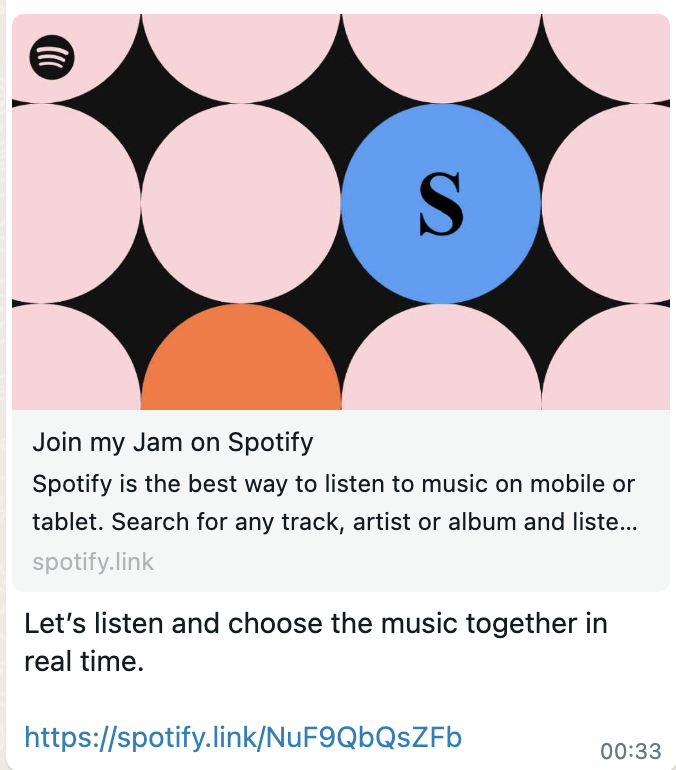
Previously called ‘group session’, this type of listening party was first introduced by Spotify in 2021, and transformed into ‘Spotify Jam’ in September 2023. I had missed this as I had moved away from Spotify in protest against Joe Rogan getting paid by Spotify to platform antivaxxers, but was instantly fascinated by this social function of the platform, as it creates a form of democratisation over the party playlist.
Joining a ‘Jam’ allows all guests to add to a playlist from their own devices that gets broadcast through a single speaker – the DJing-task was thus decentralized. The ‘jam’ function afforded a level of anonymity in the physical realm, since you had to open the Spotify app to know who picked a song, reducing the potential for ‘AUXiety’. When the host enables it, all users also get control over which song gets played next. This also means they can push songs down in the queue, end a song, or even delete the queue; a host of actions that were not attributable to specific users in the Jam. Since the playlist’s locus of action is decentralized to everyone’s mobile phone and accessible to all, the Jam can be democratising but also create a hidden struggle for control.
This new feature can therefore be a recipe for some good old norm conflict (which just so happens to be the topic of my PhD).
You must know, my Belgian friends can get very intense about music. They have a certain sensitivity for which songs should follow each other (the vibe shift needs to ‘work’) and make no qualms of putting their song first if they feel it fits the vibe better. They also have a tipping point for when to end a song; most songs should not be played entirely, (“4minutes is long!”) but we should at least hear the chorus. When we’re many wanting to play something, cutting a song short also offers space for more songs, so these actions are not frowned upon when there’s many DJ internets. I came to realize these are some pretty established norms among this friend group, yet they are not obvious to an out-group, especially when it is not clear who is doing what. In the past when the playlist and output device had a central location in the physical space, it was also obvious who to direct grievances to and sort out disagreement. With the Jam, these actions are obscured from the physical realm.
I had not been properly paying attention to the music, casually dropping in and out on the dancefloor, when I noticed a song was abruptly switched after 15 seconds. I asked what happened to one of my Belgian friends, whom I knew would be consumed by the playlist, and he complained that he doesn’t know who’s doing this – the queue had also disappeared a few times. He bitterly said he had a suspicion, pointing across the room. I casually went to confront our suspect, and after some chatting I found out our new Mexican friends had apparently been diligently putting their songs in the queue but kept getting other songs put above his, so theirs were never played. And when they finally were played, they felt it was cut short unfairly (“ALL 6 minutes deserve to be played!”). They weren’t really sure who was doing this, so getting frustrated, he and his friends had started skipping the songs that were put in front of his songs, almost culminating into a conflict on the dancefloor.
Queueing is a very culturally determined practice and I’ve seen norms clash over it so often – I still remember the desperate look on my Australian friend’s face after he had been trying to get a drink for half an hour at a busy Brussels bar. The later it gets, the more these queues devolve into a ‘work your elbows in the crowd till you touch the counter’ – type of ‘queue’.
It makes sense that there are also different normative practices around queueing songs, though there’s two elements that differ from physically waiting in line; queueing a song has an effect on more than just the person choosing the song – it’s a decision that affects the collective; and the platform architectures of Spotify’s Jam shape the visibility of queues differently than in the physical world, as the actions of skipping and changing the order are not attributable. This complicates communication on how to find a consensus among differing norms.
In the end my curiosity on our Spotify practices (and some welcome reflections by my Turkish partner) made me capable to broker peace between the different groups (I guess 2024 will not be the year where I stop meddling!). I explained to my Mexican friends that it wasn’t a case of malice, it was just a different norm, but that I understood how it feels unfair, and I told my Belgian friends what I had learned from my Mexican friends. At first my Belgian friend said that if they really wanted to play their songs, they should switch to their song when the time is right, but I pointed out that this “right” time is not obvious for people who have not partied with them before. They reconciled and admitted that there is perhaps a clash of norms, and we managed to continue partying together with a clearer communication over the shared playlist.
There were two more pieces worth mentioning on the social shaping of Spotify’s jam function; the role of digital literacy, and the possibility for capitalist stratification.
I noticed that some people did not fully understand how to add things to the queue, which led to some queues accidentally being wiped and songs skipped. Again, without visibility over such actions, malice was assumed and added on top of the frustration both sides felt. Hanlon’s razor is thus best applied to Spotify’s Jam! Some were off by a lot (as one can expect at a New Year’s eve party) with the hilarious incident of my not-very-sober friend who took the whole Spotify jam off the speakers to connect her phone, as she thought we were all just one by one connecting to the speakers. She abandoned her autocratic DJing after one song, so we took the jam back online.
We also noticed how easy it would be for Spotify to create inequality in the system. For a moment in the beginning we thought Spotify had made a tiered system where its premium users would have their songs appear at the top of the queue, but as the evening progressed this did not seem to be the case anymore. I can just imagine Spotify would not be peeved with its capitalist mindset to give more social power to their paid customers… For now Spotify seems to have resorted to an autocratic option (where the host can control the order and all other users can only add to the queue) or a fully democratic option, with the potential for chaos and norm conflict.
In any case, I had a fun evening, seems like I can’t ever fully let go of my PhD (go check out my paper on the shaping of social norms by platform architectures if you enjoyed this) but I guess by now we all know the answer to the question whether I’m “fun at parties” :’)
Photo by Point Normal on Unsplash
 Nathalie Van Raemdonck
Leave a comment