affordances antivaccination bluesky Capitalism cyber politics Cyber War digibesitas Digital amnesia Digital Community disinformation Facebook GDPR Gender human rights information war instagram International Politics Internet of Things Introspections obsolescence privacy Protests radicalisation Reddit Russia social media social norms Spotify twitter US
-
Where Does Power Consolidate on Bluesky?
This piece appeared on Tech Policy Press and in Dutch on SamPol.
In a matter of weeks, millions of X (formerly Twitter) users moved out of Elon Musk’s dark cave and sought the ‘blue sky,’ writes Nathalie Van Raemdonck. Since the US election and the appointment of Elon Musk to a position advising President-elect Trump, users have been faced with a fait accompli that the X platform will be a propaganda tool for the incoming president and his far-right politics. But where does power consolidate in Bluesky, the decentralized network that has emerged as a favored alternative to X?
Much has already been written about the demise of X (formerly Twitter) and the increase in hate speech, misinformation, and manipulation by its leadership. As academic Robert Gehl writes, X is basically equivalent to Truth Social now. Other competitors, such as Mark Zuckerberg’s Threads, tried to catch waves of emigrating social media users, even though the platform’s algorithms mostly foster engagement bait. Many also flocked to the decentralized fediverse in 2022, where the Twitter analog Mastodon caught a wave of users traumatized by authoritarian Silicon Valley leadership. Users of the Fediverse, however, argued over how they did not want to be the new Twitter replacement, as there is a strong preference for ‘local vibes’ and decentralization as opposed to ‘big world’ social media.
None of these replacements were as successful in providing an accessible and familiar alternative to X as Bluesky appears to be. However, the central question that should be on everyone’s lips is, where is the locus of power in Bluesky?
Bluesky and corporate takeover
The biggest headache when considering the future of Bluesky is how a repetition of a Musk-like takeover scenario can be avoided. Tech critic Cory Doctorow recently questioned how Bluesky is armed against “enshittification,” a term he invented to describe the process that all Big Tech platforms seem to go through to satisfy their need to make money and deliver a return to investors. One day, the bills for server costs and developers will somehow need to be paid. Those who put up the capital might also be able to bend the platform to their will. So, Doctorow asks, how can we be certain we will not be trapped and held hostage again on this platform after investing the time in developing a social graph? The developers of the platform know this themselves; their motto is that the company itself could become the platform’s future enemy. That’s why it’s built with a decentralized protocol, unlike the walled gardens Big Tech has built over the past decade. We need to dive into some technical explanation to fully understand what makes Bluesky different and how there is still power consolidation, despite best intentions.
In decentralized networks, the idea is that users can continue to communicate with each other regardless of what platform they are on and what server their data is stored on. To that end, Bluesky, the company, developed the ATprotocol, which is the basis of the ‘ATmosphere.’ In the ATmosphere, different applications can be built, such as the Bluesky platform. In practice, Bluesky is currently the only prominent platform, despite there being some interesting development projects, but technically anyone could create a new application, and even copy Bluesky’s code, given that it is open source.
When it comes to the decentralization of servers, currently, new accounts on Bluesky are automatically stored on a Bluesky server, and moving away requires some technical skills and small payments for server space, but it is not impossible. To understand how this combination of accounts and platforms works in practice, I draw from an explanation journalist Laurens Hof made on the conceptual model of the ATmosphere. All accounts in the ATmosphere are a bit like websites, with Bluesky as the platform serving as the indexer, just as Google is the indexer of the Web. The websites you see in your search results exist independently of Google, and so do the accounts in the ATmosphere. We have other search engines like Bing, Yahoo or DuckDuckGo, but people prefer the indexer that they find most user-friendly or yields the best results.
If there were cause to migrate, people could move away from Bluesky as their main indexer, but many might not because of convenience or lack of technical skills. This would mean if people like Cory Doctorow moved away within the ATmosphere, their network would still be subjugated to whatever future Bluesky has up its sleeve, which can impact the communication of those networks. So while in theory, the system is much more open and resilient to central control than X, in practice, individuals are still required to move away from the platform and servers in droves, which makes it difficult to change course. Thus, there is a prospective threat to collectives that also deserves attention.
A middleware solution to speech
How Bluesky can be influential as an “indexer” and threaten such networks is similar to how Google chooses which websites to show and how to rank search results. The Bluesky developers conceived their model of the ATmosphere in such a way that “speech” and “reach” would operate on two different layers, giving users a choice over the second in terms of what content could reach them personally. This leads to a libertarian interpretation of free speech, which TechDirt founder Mike Masnick advocated for in his seminal ‘protocols not platforms’ essay, which heavily inspired the development of Bluesky. The kind of logic where the user decides what kind of ‘awful but lawful’ speech they want to see was dubbed the ‘middleware solution’ by a Stanford group led by political scientist Francis Fukuyama. Actions against the ‘speech’ layer are limited to illegal content, such as images of child abuse. These would be removed by Bluesky from its servers and app.
Regarding the reach layer, Bluesky developed an innovative decentralized approach to maintain its libertarian management of free speech, which is composed of at least three parts. The first is stacked moderation. Bluesky has a team of labelers whose job is mainly to “label” content that might be harmful but lawful. Currently, there are labels like “rude,” “discriminatory,” “misinformation,” or “sexual content,” but also labels like “self-harm” and “illegal goods” exist. Users can choose whether they want to see labeled content, see it only with a warning label, or hide it completely in their app. This means Bluesky retains the power to label, but users have the individual power to not enforce these labels. This means it is quite possible for two people to follow the exact same people but not see the same posts. Other users can also create such a labeler and have people report to this specific labeler. This complements Bluesky’s built-in labeling, bringing decentralization within the platform.
The second way Bluesky shapes “reach” differently is through what they call ‘the marketplace of algorithms.’ This allows users to develop their own algorithmic feeds in Bluesky. Other users can subscribe to such feeds and thus control their own timelines; for example, one can choose to only see the ‘quiet posters’ they follow, see the content of their mutuals that gained the most traction first, or only see people posting in Spanish.
The third way is moderation lists, where users can create lists of people they prefer not to see or even prefer to block. Other users can also subscribe to those lists, and new additions to that list are automatically muted or blocked by subscribers as well. This creates the possibility that people who end up on such a list become invisible to large groups of list followers who may or may not be aware of everyone on that list. As journalist Charles Arthur describes, some former X users have already decried being added to heavily subscribed blocklists based on wild or speculatory accusations.
From the combination of these user-governed moderation layers, entire architecturally delineated communities can emerge on the platform, as is the case for BlackSky. User and developer Rudy Fraser developed a combination of feeds, labeling, and moderation lists that was named BlackSky, a ‘place’ in the ATmosphere where Black people could find each other without becoming a target for people with bad intentions. The idea was not to create a segregated corner for Black people but to ensure that people could see each other in a crowded room and know that they were not alone. Minority groups are often more affected by online harassment and count as the canary in the coal mine that more quickly senses that something is wrong in our public spaces. It makes sense, then, that BlackSky would be a forerunner in testing out how Bluesky offers protection.
When it comes to power decentralization, it is clear that users get a lot of choices, but these choices are all still contained within the Bluesky platform. Lists and feeds can also be reported to Bluesky who can take them down. It is also clear that certain users have a lot of power over what content others can see. Anyone who subscribes to a feed, labeling, or moderation list is dependent on the choices and also whims of its administrator. That administrator thus becomes a de facto norms leader. In theory, anyone has the ability to create a competing feed, labeler, or moderation list, but there is a first-mover advantage where people stick with the first one that’s gained prominence. In practice, one also needs some basic technical knowledge to set it up and energy to maintain it. Power always thus concentrates somewhere in certain leaders, even in decentralized systems.
Call-out culture vs mute culture
When it comes to social dynamics, Bluesky clearly differs from X in several ways, especially in how users deal with people who break their social norms. On X, a call-out culture (also pejoratively called “cancel culture”) emerged in part because of the platform’s architecture. The platform’s openness lets content reach many different corners of the internet, leading more often to what researcher danah boyd coined context collapse. This means people constantly come into contact with other people who have different social norms, often leading to conflict and possibly public reprimanding, a “call-out.” This is often accompanied by what researcher Alice Marwick describes as morally motivated networked harassment, a way of silencing people by rallying troops that enforce their perspective of ‘right norms.’ The alternative proposed by Bluesky is to make people with whom one clashes invisible to themselves and possibly others in their network. This is what the ‘freedom of speech does not guarantee freedom of reach’ approach is about.
Is either system “better”? and if so, better for whom? People who disproportionately face online harassment may be able to better protect themselves on Bluesky. At the same time, Bluesky’s atomized moderation may also ostracize those who want to have difficult but necessary conversations about, say, racism or genocide in Gaza (topics that would likely not lead to such muting on Bluesky at the moment as researchers found that the platform currently has a predominantly center-left population). Polarizing voices can become invisible in a public sphere that would rather not be confronted with them, even if political polarization is sometimes needed to enact change.
Of course, not ‘seeing’ certain actors might also fend off affective polarization, as some research shows the trenches of partisanship are often deepened by interacting or merely seeing opposing views. Yet as Diana Mutz writes, it is important for democratic systems that there are still opportunities to reach across the aisles. Political theorist Chantal Mouffe calls her ideal model of public deliberation “agonistic” as opposed to “antagonistic,” where citizens can have political confrontations to come to a “conflictual consensus” on society.
Whether large, open, many-to-many platforms like X and Bluesky are the right space for this is food for discussion. However, it’s certain that the decentralization of Bluesky does not just apply to technology but extends into communities. As academic Christina Dunbar-Hester already observed in different decentralized networks like Mastodon, there is a certain loss of “collective conversation.” Due to what she terms “lossy distribution,” a shared reality can fragment if some participants in a discussion are hidden from some other participants.
In conclusion, Bluesky is more resilient to a hostile takeover than current Big Tech social media platforms. There is, as ActivityPub co-founder Christine Lemmer-Webber calls it, a ‘credible exit’ within the ATmosphere if leadership changes. Power, however, consolidates in the ATmosphere with Bluesky, both in the company and in certain users. This can both make for healthier social interactions and potentially fragment the public sphere at the whims of certain powerful users. Only time will tell how well the emergency exits work and in what ways Bluesky will become the new online “town square.”
-
The threat of disinformation can be worse than disinformation itself
This article originally appeared in Dutch for SamPol Magazine.
As several countries have introduced new legislation to put a stop to disinformation, those laws can also be abused to silence the independent press.
According to the World Economic Forum, “AI-generated disinformation” will be the biggest threat for 2024. For its Global Risks report, experts and policymakers are annually asked to look into their crystal ball and predict the state of the world. In the 2023 report, disinformation was still nowhere to be seen in the top ten, but this year it even surpassed “extreme weather events,” which has dangled (appropriately) in the top three for a decade.
This incredible rise in the threat of disinformation is curious, yet not unexpected. Some 4 billion people will vote in democratic elections in 2024; citizens in the U.S., India, Indonesia, Mexico, all of Europe and, of course my country Belgium, among others, will be casting their vote. And this after a year of dizzying AI developments where ever more realistic images and texts are artificially generated, in an era where, according to the Digital News Report, there is a global record of news avoiders. It seems like a perfect storm.
The fear of disinformation focuses most on elections because it is a moment where an opinion gains real power in the form of a vote. Influencing that opinion with lies, rumors and half-truths could lead to drastic shifts in power. However, it is difficult to measure what impact disinformation effectively has on such an opinion shift; a political vote does not simply change quickly because of a lie. Time and again, researchers find few significant correlations between fake news and election results, only that the convinced become even more convinced.
So we should take this threat of disinformation for power shifts with a grain of salt, and certainly the AI factor. Some politicians keep sharing obvious satire or poorly photoshopped disinfo over and over again, which passes almost silently among their constituents. What does that say about where the problem really lies?
The threat of disinformation can also have unintended consequences. Indeed, several studies show that widespread fear of disinformation actually leads to increased distrust in established media and even a reduced ability to identify disinfo. A “backfire effect” that has long been warned about when media literacy is based solely on increasing skepticism, and not on regaining trust in journalism and science.
Moreover, the threat of disinformation can also lead to a reaction that becomes more dangerous than the actual effects of disinformation. There, too, scholars found that greater fear of disinformation leads to greater support for undemocratic interventions. Several countries have created new legislation in recent years to call a halt to disinformation. But “fake news” is often not clearly defined. As a result, these laws can also be abused to silence independent press. According to the Committee to Protect Journalists, some 39 reporters worldwide have even been imprisoned by this type of legislation.
In Europe the Digital Services Act (DSA) entered into force on Feb. 17. This vital legislation imposes certain much-needed transparency obligations on VLOPS (euro-lingo for Very Large Online Platforms) and gives users more opportunities to appeal moderation decisions made by the platforms. However, the legislation can also be used as a blunt instrument by platforms when they are required to engage in “risk mediation”.
This was made clear recently when Thierry Breton invoked DSA obligations around harmful content when hate speech and disinformation spread on various social media platforms following Hamas’ Oct. 7 attacks on Israel. Research by NGOs such as Human Rights Watch and the Arab Center for the Advancement of Social Media found that platforms like Meta systematically silenced voices advocating for human rights in Gaza during that period. They were lumped into the same category of “Hamas glorification”. Although the DSA has various provisions and safeguards against unilateral and political interventions, a threat of legal obligations by zealous bureaucrats can lead to the hasty removal of content by the platforms.
Disinformation can certainly pollute debates, protests and legit criticism; it is the Achilles heel of liberal democracies that value free speech. That openness is also eagerly exploited by those who do not care about the importance of keeping the public space open. But with too narrow a restriction on freedom of speech, one can also stifle those who raise social injustice. The biggest mistake that can be made is to suppress legitimate criticism as a ‘precaution’.
There are unpleasant conclusions to be drawn from the WEF forecast, where legitimate concerns such as the “cost of living” and the “housing crisis” drop in the rankings and are replaced by the threat of disinformation. If we really want to protect elections against undemocratic actors, it doesn’t help to attribute social unrest to an allegedly deceived public. That kind of thinking leads to simple solutions that can make complex problems worse.
-
“Play my damn song!” Social norm conflict over Spotify’s Jam feature
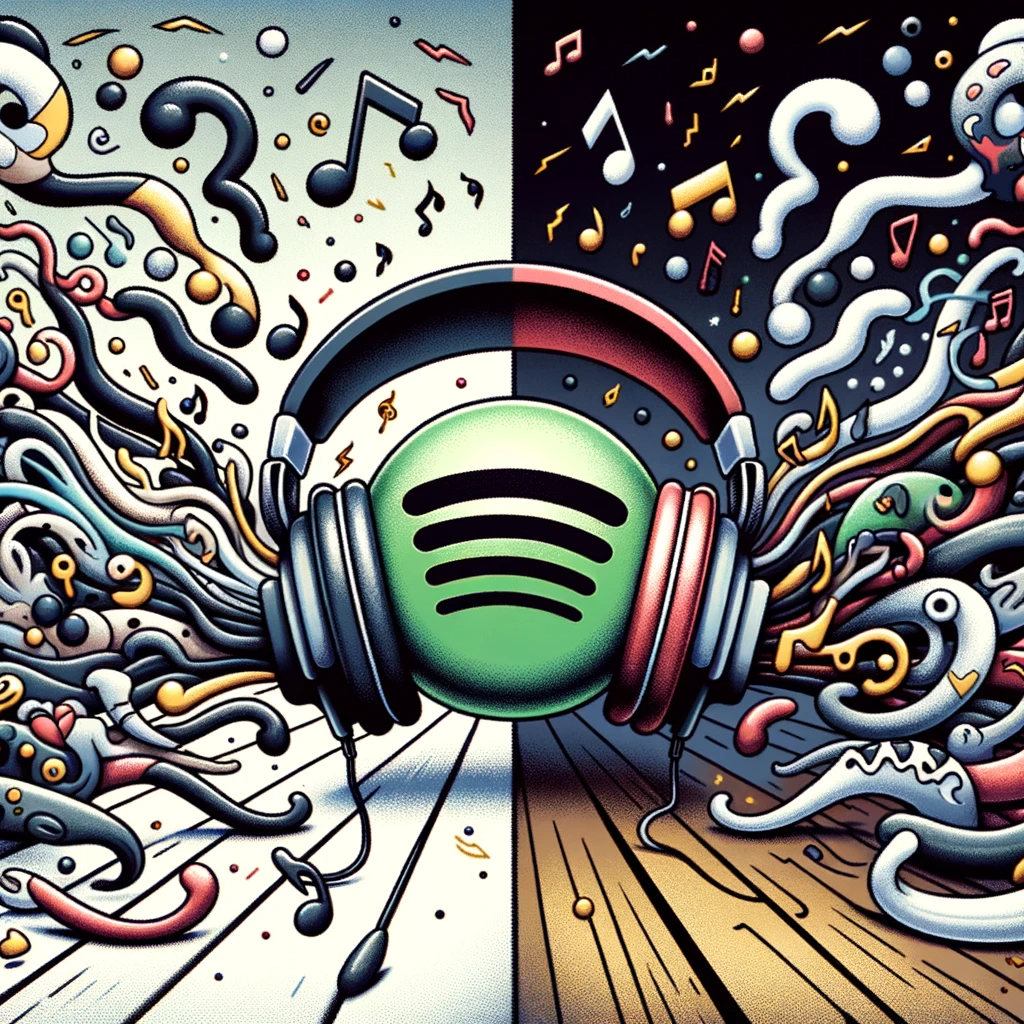
It had been a while since i’d been to a house party where we played music and danced. Back in the days (mostly pre-pandemic), houseparties with my predominantly Belgian friends would revolve around one laptop where people would add songs, or one phone that would get passed around. When folks would start dancing and hyperfocussing on the music, there would be several contenders for what we dubbed “DJ internet”, adding songs to the queue on Youtube and later Spotify. Certain norms started forming at our parties that only became fully clear to me last night at a new year’s eve party, as those hidden rules underlying ‘our’ party clashed with other norms. The affordances of Spotify’s new Jam function played an important shaping role.
To set the scene: I went to a New Year’s eve party in Brussels hosted by one of my best Belgian friends and her Mexican partner with whom she was about to move in. The mix of guests was thus Belgian and Mexican, with two odd Turks.
At a certain point past midnight, our Mexican host had shared a link to Spotify’s new collaborative party playlist.
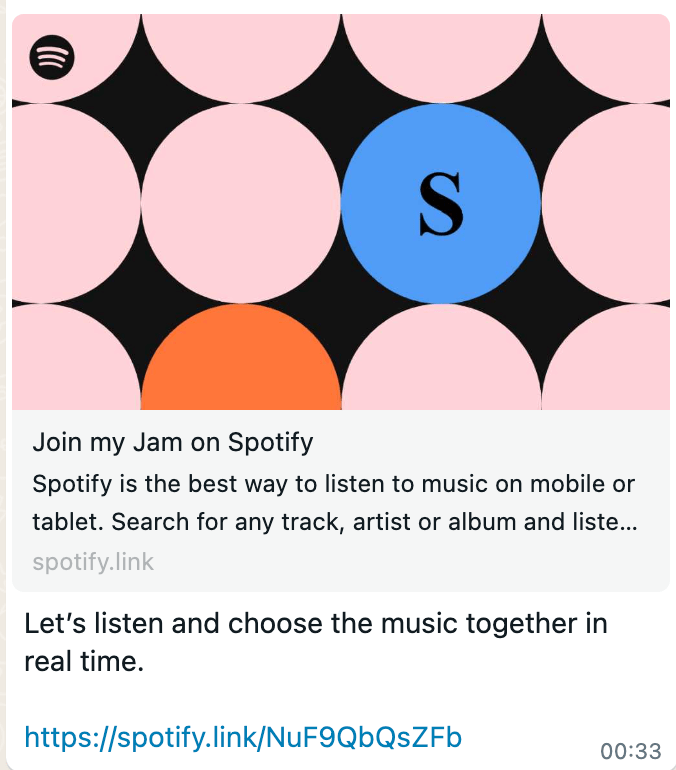
Previously called ‘group session’, this type of listening party was first introduced by Spotify in 2021, and transformed into ‘Spotify Jam’ in September 2023. I had missed this as I had moved away from Spotify in protest against Joe Rogan getting paid by Spotify to platform antivaxxers, but was instantly fascinated by this social function of the platform, as it creates a form of democratisation over the party playlist.
Joining a ‘Jam’ allows all guests to add to a playlist from their own devices that gets broadcast through a single speaker – the DJing-task was thus decentralized. The ‘jam’ function afforded a level of anonymity in the physical realm, since you had to open the Spotify app to know who picked a song, reducing the potential for ‘AUXiety’. When the host enables it, all users also get control over which song gets played next. This also means they can push songs down in the queue, end a song, or even delete the queue; a host of actions that were not attributable to specific users in the Jam. Since the playlist’s locus of action is decentralized to everyone’s mobile phone and accessible to all, the Jam can be democratising but also create a hidden struggle for control.
This new feature can therefore be a recipe for some good old norm conflict (which just so happens to be the topic of my PhD).
You must know, my Belgian friends can get very intense about music. They have a certain sensitivity for which songs should follow each other (the vibe shift needs to ‘work’) and make no qualms of putting their song first if they feel it fits the vibe better. They also have a tipping point for when to end a song; most songs should not be played entirely, (“4minutes is long!”) but we should at least hear the chorus. When we’re many wanting to play something, cutting a song short also offers space for more songs, so these actions are not frowned upon when there’s many DJ internets. I came to realize these are some pretty established norms among this friend group, yet they are not obvious to an out-group, especially when it is not clear who is doing what. In the past when the playlist and output device had a central location in the physical space, it was also obvious who to direct grievances to and sort out disagreement. With the Jam, these actions are obscured from the physical realm.
I had not been properly paying attention to the music, casually dropping in and out on the dancefloor, when I noticed a song was abruptly switched after 15 seconds. I asked what happened to one of my Belgian friends, whom I knew would be consumed by the playlist, and he complained that he doesn’t know who’s doing this – the queue had also disappeared a few times. He bitterly said he had a suspicion, pointing across the room. I casually went to confront our suspect, and after some chatting I found out our new Mexican friends had apparently been diligently putting their songs in the queue but kept getting other songs put above his, so theirs were never played. And when they finally were played, they felt it was cut short unfairly (“ALL 6 minutes deserve to be played!”). They weren’t really sure who was doing this, so getting frustrated, he and his friends had started skipping the songs that were put in front of his songs, almost culminating into a conflict on the dancefloor.
Queueing is a very culturally determined practice and I’ve seen norms clash over it so often – I still remember the desperate look on my Australian friend’s face after he had been trying to get a drink for half an hour at a busy Brussels bar. The later it gets, the more these queues devolve into a ‘work your elbows in the crowd till you touch the counter’ – type of ‘queue’.
It makes sense that there are also different normative practices around queueing songs, though there’s two elements that differ from physically waiting in line; queueing a song has an effect on more than just the person choosing the song – it’s a decision that affects the collective; and the platform architectures of Spotify’s Jam shape the visibility of queues differently than in the physical world, as the actions of skipping and changing the order are not attributable. This complicates communication on how to find a consensus among differing norms.
In the end my curiosity on our Spotify practices (and some welcome reflections by my Turkish partner) made me capable to broker peace between the different groups (I guess 2024 will not be the year where I stop meddling!). I explained to my Mexican friends that it wasn’t a case of malice, it was just a different norm, but that I understood how it feels unfair, and I told my Belgian friends what I had learned from my Mexican friends. At first my Belgian friend said that if they really wanted to play their songs, they should switch to their song when the time is right, but I pointed out that this “right” time is not obvious for people who have not partied with them before. They reconciled and admitted that there is perhaps a clash of norms, and we managed to continue partying together with a clearer communication over the shared playlist.
There were two more pieces worth mentioning on the social shaping of Spotify’s jam function; the role of digital literacy, and the possibility for capitalist stratification.
I noticed that some people did not fully understand how to add things to the queue, which led to some queues accidentally being wiped and songs skipped. Again, without visibility over such actions, malice was assumed and added on top of the frustration both sides felt. Hanlon’s razor is thus best applied to Spotify’s Jam! Some were off by a lot (as one can expect at a New Year’s eve party) with the hilarious incident of my not-very-sober friend who took the whole Spotify jam off the speakers to connect her phone, as she thought we were all just one by one connecting to the speakers. She abandoned her autocratic DJing after one song, so we took the jam back online.
We also noticed how easy it would be for Spotify to create inequality in the system. For a moment in the beginning we thought Spotify had made a tiered system where its premium users would have their songs appear at the top of the queue, but as the evening progressed this did not seem to be the case anymore. I can just imagine Spotify would not be peeved with its capitalist mindset to give more social power to their paid customers… For now Spotify seems to have resorted to an autocratic option (where the host can control the order and all other users can only add to the queue) or a fully democratic option, with the potential for chaos and norm conflict.
In any case, I had a fun evening, seems like I can’t ever fully let go of my PhD (go check out my paper on the shaping of social norms by platform architectures if you enjoyed this) but I guess by now we all know the answer to the question whether I’m “fun at parties” :’)
-
Why is it so hard to let Musk’s leadership sink in?
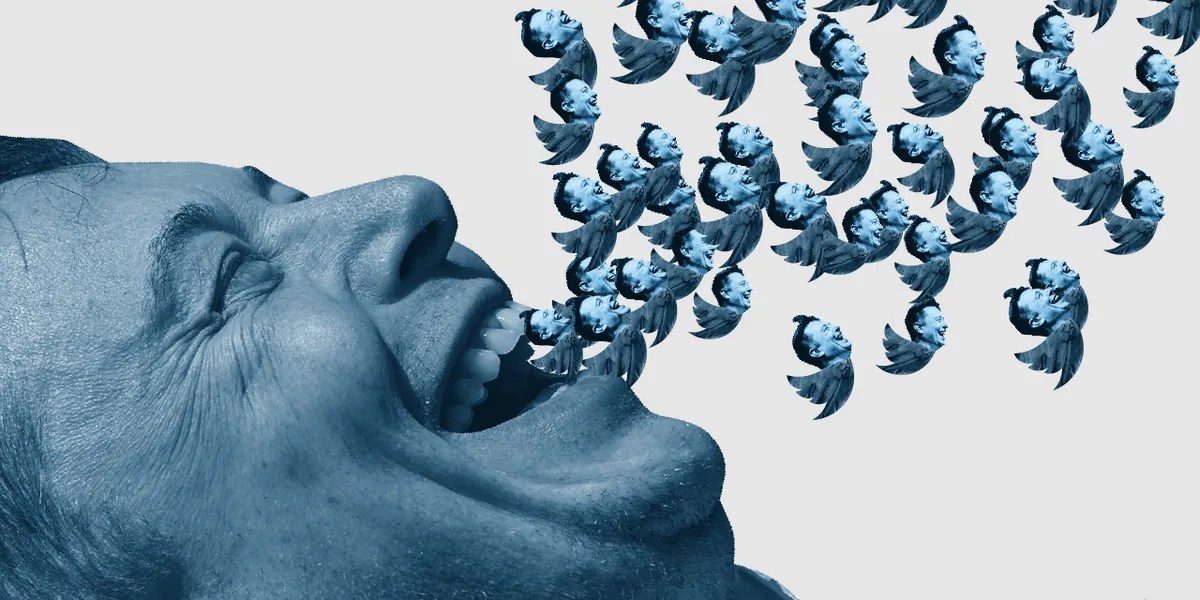
(this piece previously appeared in Dutch in Knack)
With a kitchen sink he entered Twitter’s headquarters on Friday, making it clear to everyone that they should acquiesce to his takeover. “let that sink in”.
Why do so many people find it hard to let it sink in that Musk is now at the head of Twitter? Alarm bells go off for many that Donald Trump is coming back, along with a bunch of other foul-mouthed tweeters. Promises to make Twitter an “everything-app” like China’s We-chat make many shudder, as well as suggestions that misinformation is just an opinion, which Musk illustrated on his second day by tweeting a conspiracy theory about the attack on Nancy Pelosi’s husband.
To be clear, Twitter is bound by legislation that pretty clearly defines how the platform is responsible to remove hate speech. The platform has also committed to following the European code of practice against disinformation, and the just-passed European Digital Services Act will also impose additional rules on the platform. As European Commissioner Thierry Breton tweeted on Friday, the Twitter bird will have to fly by EU rules.
At the same time, there is a lot of toxicity on the platform that is not illegal but unpleasant enough to make people’s lives miserable online, and there’s plenty of dubious information circulating on Twitter can take on a life of its own.
My main concern for Twitter lies in its architecture as a social medium, which is among others the focus of my PhD dissertation. That is because Twitter’s architecture has a direct consequence for the role Musk will be carrying from now on. Twitter, sometimes called “the hell site” by its users, is known as a platform with a lot of bickering. Although it is the source of many memes and interesting discoveries, discussions can get incredibly toxic. That’s in part due to the way Twitter is built. Whereas profile platforms like Facebook are built more like cul-de-sacs, places where people stay in conversation with their contacts and where the occasional visitor drops by, Twitter is built more like a busy city where different types of people are constantly interacting. As such, it regularly clashes between different norms of socially acceptable behavior. Years ago, the communication scientist danah boyd gave this phenomenon the name “context collapse,” a coming together of different contexts that collapse into each other with all its consequences. It is not uncommon for this to lead to conflict and for a norm to be enforced aggressively by a few outspoken users. At such moments, there is a need for community moderators. See it as a type of social worker who intervenes in disputes and urges people to calm down or return to their own neighborhood. If necessary, virtual police can also intervene to maintain order when things get out of hand.
The ability to intervene at Twitter falls almost entirely on the shoulders of the platform itself, and since Friday on those of the chief Twit himself; Elon Musk. Indeed, on Twitter, there is little room for community social workers. When users respond, it will rarely calm things down. On the contrary, such interactions actually elicit more algorithmic visibility due to Twitter’s architecture, which can reach even more participants from other contexts, resulting in even more clashing norms. At worst, some accounts are also picked out by tweeters with a big reach and end up in a Twitter storm. Thus, they can get the full brunt of hundreds, sometimes thousands of accounts. Such harassment need not exceed the boundaries of hate speech to make people miserable. ‘Networked harassment,’ as it is called, has impact because of its scale. The only defense users have in such cases is to put their accounts on private, which basically locks them in a silo in the virtual city, or block people, which in the case of networked harassment can feel like fighting an uphill battle. The last remedy then basically leaves users to not participate in discussions, or leave the platform.
This is why it’s important for Elon Musk to recognize his crushing responsibility to moderate as virtual police. Not that Twitter has done this in any particularly transparent or balanced way so far, but Musk has made it very clear that he prefers to do as little content moderation as possible. He wants to limit himself only to what is established by law as illegal speech. (I won’t even go into how that means he’ll likely comply with authoritarian countries that have criminalised criticism of the government…) But he claims his minimal intervention strategy is necessary to ensure freedom of speech as much as possible.
What he does not seem to understand is that it is not content moderation but rather the lack of content moderation that harms freedom to speak out the most. When the line of decency is very low, nuanced voices are pushed out left and right, and minority voices that are inconsistent with the most common norm are suppressed by the loudest and most dominant voices. Mckay & Tenove also warned for ‘unjustified inclusions of falsehoods’, where democracies that give space to falsehoods displace and devalue the contributions of legitimate members of the public.
Weaker moderation policies ironically hurts free speech: The voices of real users will be drowned out by malicious users who manipulate Twitter through inauthentic accounts, bots and echo chambers. Only those with elephant skin, or mildly masochistic traits in the face of so much hostility, will stay on Twitter. Musk stated Friday that he sees a danger of social media breaking down into far-right and far-left echo chambers. Ironically, a lack of proper moderation could have this very effect on Twitter. in French there is a saying “Quand tous les dégoutés s’en vont, il n’ya que les dégoutants qui restent”.
The average reader may wonder why this is actually such a big deal, it is estimated that only 5-10% of Belgian Internet users have an active Twitter account. Yet many politicians, scientists and “something-ists” on the platform often behave as if the whole world is watching. Since Twitter is a medium where many journalists pick up information, this is unfortunately also often the case as those voices get amplified through traditional media.
Due to poor moderation in recent years, there has already been a drain of minority voices on the platform, which may get worse under Musk’s policies. This is unfortunate because due to that aforementioned context collapse, Twitter is also a place where interesting exchanges happen between people from many different disciplines and walks of life. When minorities and nuanced voices are systematically pushed away in a place where the media often gets the mustard for what “lives” in society, we are once again served the same sameness.
We should give Musk the benefit of the doubt; he himself has tweeted that he does not want his 44 billion investment to become a “free-for-all hellscape. But the firing of the “trust and safety” officer on his first day shows that Musk already has his own interpretation of what a comfortable platform looks like. For some, it will be an anxious wait to see how he plans to fill his role as the guardian of this platform, and whether his leadership will not sink the entire Twitter ship.
-
Cyberdiplomacy at the EU – insights and personal efforts
On January 30th 2021, I ended a 2,5 year adventure working in the European Union institutions. I spent this time at the EU Institute of Security Studies, the EUISS, where I worked on the EU Cyber Direct project, providing research support to the European External Actions Service in its cyberdiplomacy endeavours. I have decided to dedicate my full time on my PhD research at the Vrije Universiteit Brussels at IMEC-SMIT and the Brussels School of Governance, where I will be part-time affiliated with the Hannah-Arendt Institute. My doctoral research will focus on platform architectures, the organic spread of misinformation and online radicalisation and the ways platforms shape the agency users have to shape social norms around content sharing.
My time at the EU left me with many impressions and some accomplishments. At the start of the experience it felt like I had been living in Rome all these years and was suddenly summoned to work in Vatican City. The impressive architecture of institutional buildings in Brussels, which I had so often walked past as a Brussels citizen, now felt like cathedrals for democracy (and bureaucracy…). The centrality of Brussels in the European empire, even more epitomised by the inner Brussels bubble and hierarchies, its jargon and odd customs,… at times working for the EU felt similar to working for the Holy Roman Empire. These cynical feelings eventually subsided as I started understanding more about the inner workings of the greatest peace project (and experiment?) ever set up. I gained some respect for the work of the European Union, despite all its defects.
I spent my time at the EUISS providing research support for the EU’s cyberdiplomacy efforts. The EU has many diplomatic endeavours in connecting with countries in the digital landscape, one of them is cybersecurity focused. As every country in the world is navigating its way through the digital revolution, The EU deemed it important to understand how everyone perceives their route. Mass societal connection to the information highway brings many benefits, but also exposes society to many vulnerabilities that are hard to deal with. It’s no secret that some countries have been taking advantage of these vulnerabilities. There’s strategic benefits for these countries in exploiting the digital holes that are left behind while we’re all building digital infrastructure at a breakneck speed. I learned that the EU seems to want this global occurrence to be a collective endeavour where citizens protection online is the main priority (with protection very much interpreted from a liberal-democracy perspective).
Such a collective liberal-democratic strategy previously paid off after the European continent was ravaged by internal war. Cooperation works from the EU’s perspective. In the few years that I was working on the EU Cyber Direct project, I saw an EU trying to understand other countries and regions’ cybersecurity positions in order to adapt its cooperation ideas to the preferences of everyone participating in the global digital space. I saw how the EU and its member states have tried to broker conversations at the United Nations for peace and stability (often too careful in condemning allies) and support other countries in developing cybersecurity strategies.
A more cynical reading of these efforts is that the EU and other global powers prefer other countries to get ready for state-sponsored cyber operations. If countries know how to prevent devastating consequences and unintentional loss of human lives caused by cyberattacks, it will allow technologically advanced countries to wage cyberwar more efficiently. Though never acknowledged as one of the EU’s policy goals, the EU’s cybersecurity capacity building was probably not only coming from a perspective of peace and love for all citizens of the world.
While such a policy perspective is not one I endorse, I did salute the capacity building support and traveled around the world to speak about how the EU does its internal cybersecurity cooperation. Not to push a strategy for completely different regions in the world, but mainly to exchange best practices. Traveling for these conferences gave me new insights on how we think about security of the internet from different perspectives. I bundled these insights in 3 regional engagement mappings for the European External Action Services, one on Latin-America, from which I condensed my analysis of the region’s balancing act in a blog post for the Elcano Institute, one on Africa, and one on Southeast Asia. There is no right or wrong way to do cybersecurity in the end, every country and region approaches cybersecurity cooperation and awareness in ways that work for their region.
During my time working with the EU Cyber Direct project, we connected hundreds of experts, academics and digital rights activists to EU policymakers, putting them in the same room to exchange perspectives. The COVID-19 pandemic made that aspect harder, and working on cyberdiplomacy really made me understand the value of human-to-human contact. I mentioned this importance in my opening statement that I was honoured to make at the 2019 UN multistakeholder intersessional of the Open Ended Working Group (OEWG) on Developments in the Field of ICTs in the Context of International Security. I wrote about what these UN meetings are about for a Belgian audience to create more awareness on the importance of this process.
In the UN statement I made an analogy of human interaction to the DNS system. Human networks are connected through routing points, similar to computers. These human routing points have a role to play in connecting everyone in their directory to other parts of the world. This is for me what multistakeholderism is about. It is important that the people who are routing points in their local and regional communities are involved in such global processes on securing the internet. Their presence at fora like the OEWG is key to making sure a broad variety of actors has a say in the security and stability of the internet, so a robust human DNS must be built between them.
The point I wanted to make in that statement, was the need to get a variety of actors involved in the cyberdiplomacy conversation. I supported the European Security and Defense College in the creation of an e-learning module on cyberdiplomacy to demystify the concept and processes for European diplomats. The e-learning is openly accessible to anyone, as the understanding of cyberdiplomacy should stretch far beyond diplomats representing their states interest.
My time at the EUISS was not exclusively spent on cyberdiplomacy and the EU Cyber Direct project. I was grateful to also be able to contribute to the institute’s strategic foresight efforts. These allowed me to develop my insights on the security threats that stem from social media, which are not a topic of debate in cyberdiplomacy. This is also why I decided to pursue this topic further in a dedicated PhD research project.
There are good reasons to keep social media, misinformation and other content issues out of security debates, which are at the centre of cyberdiplomacy. For one, it remains problematic to securitize content, and it plays in the hands of global actors who would prefer to gain greater sovereign control over information that circulates within their borders and reaches their citizens. It does however also negate the fact that there are security threats stemming from content that circulates on the internet. On January 6th 2021, a mix of extremists, Trump supporters and conspiracists stormed the US capitol building, supposedly to ‘take back the steal’ and protest the election loss of Donald Trump. Five people died in this riot. One year earlier, we predicted a scenario of civil unrest in the US fuelled by online misinformation and extremists organising in online groups. Our scenario was supposed to take place in 2024, but perhaps the global pandemic fermented many underlying rotting issues and stank up the place faster than I expected.
Calling the January 6th incident the start of a civil war is hyperbolic, but it was symptomatic to the very real security issue stemming from the social web. The artificial wall held up in the international discussion between harmful code – harmful content also leaves a vacuum for those countries that are dealing with the growing pains of societal digital connection. There are many countries seeing the waves of instability stemming from the internet, but see no clear solution to avoid it from turning into conflict. Without global discussions on this issue, countries cannot support each other in finding viable, human rights-respecting solutions to this problem. This vacuum is easily filled by actors supporting more online repression and surveillance to guarantee stability. If I had more time and space at the EUISS, I would have still written a Brief about the need for global capacity building and best practice exchanges on dealing with disinformation in a rights-and-rules-respecting way. The EU and other countries making policy decisions however haven’t found the best approach themselves. There needs to be more evidence-based policy making first. Countries around the world need to experiment with rights-respecting interventions, acquire evidence together, adapt to local contexts and investigate the effectiveness and impact of certain platform regulations and interventions.
These issues of misinformation and online hatred fester all around the world on social platforms that are ran by companies that seem unbound by any national legislation, and unbothered by their societal responsibility or lack of democratic input. In my view, most of these platforms are inherently problematic because of the business model and architectures that guide their social interactions. That is why, as part of the What If series, I wrote out my utopian ideal of a social media platform in 2024 where users could get their news as well as engage socially.
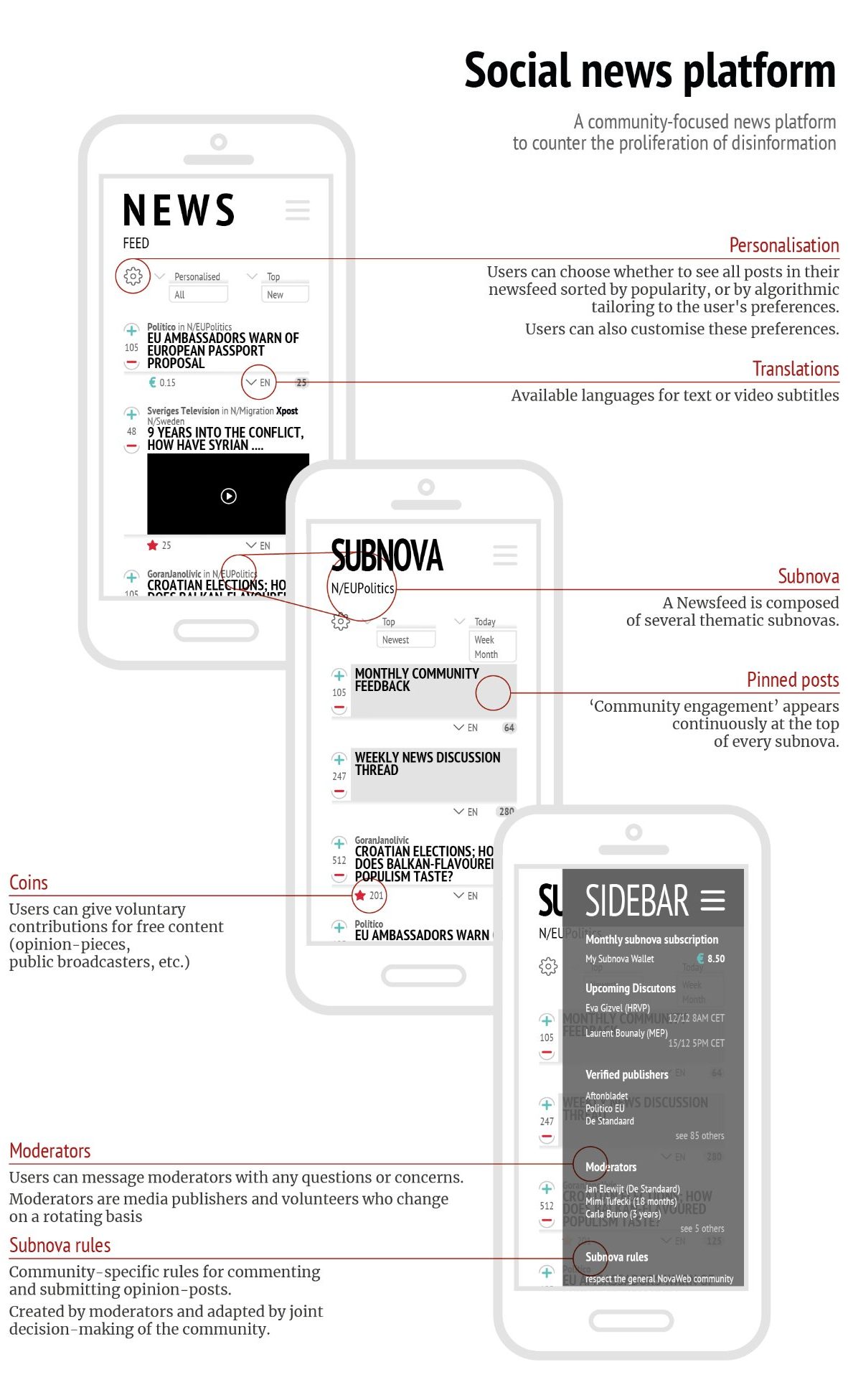
The key importance of such an interest-based social platform are: trained moderators who are part of the community, understand the norms, context and tone and can be held accountable by their community; and a subscription/wallet based monetization.
I see many challenges ahead for the open internet, as geopolitical interests are seeping into internet governance issues increasingly more often. One such example was the discussion on a potential ban of the Chinese social media app TikTok. I wrote a piece on our Directionsblog how the concerns with TikTok are framed as cybersecurity concerns, but they are actually more a matter of national security where states such as the US don’t want data of their citizens to fall into the hands of a country like China. If states truly want to tackle the security problems with platforms like TikTok, the solution is not to ban the platform and harm user rights that have formed communities on these platforms. The solution is to create a rights-and-rules based social media, for ALL social media platforms.
When the mindset of a free and open internet starts taking a backseat in security discussions, the internet will start fragmenting on several layers. A lot has been written about how the internet will not fragment, especially on the DNS layer, but geopolitics can intervene in several other layers of the internet. For the last What If scenario that I made at the EUISS, I hypothesized what a fragmented internet would really look like on a Physical, Data and Application layers of the internet (loosely based on OSI & TCP/IP model).
The global network of information has always been balancing between decentralisation and centralisation. As the balance seems to be tipping more to decentralisation, it is important to keep regions from fragmenting their internet space and cutting off or inhibiting the flows of communication.
The EU can have an important role to play in stimulating cooperation towards protecting a rule-based free and open internet. I look forward to keep working towards these goals in the future, possibly with the European Institutions but always with a sharp and critical eye on the Union.
-
What we can learn from conspiracists on social media
(Parts of this piece previously appeared in Dutch in Knack.)
By relying solely on traditional media, we might not be able to create group immunity with a COVID-19 vaccine. A wave of conspiracies has washed over the information ecosystem and play into people’s deep seated fears. Science communicators can learn from conspiracy influencers how to reach people, especially on platforms like Instagram that have become conspiracy engines. How can we work together and inoculate people against conspiracies?
When the corona vaccine arrived, it felt like the release from a terrible pandemic year, yet not everyone felt that way. Surveys around the world show that people are suspicious and do not fully trust the vaccine. While that is their right, many have become caught in anti-vaccination campaigns and doubts spread by conspiracists. People distrust the government, traditional media, and the experts who seem to be ‘selected’ to share a certain narrative. They look for answers that don’t feel spoon-fed and hereby land in the conspiracy realm. There is a whole community of antivaxxers that is having its glory days during this pandemic. While they’ve been around for a lot longer, they prey on these doubts in times of crisis, and offer answers to people with questions. Researchers found that the anti-vaccination movement on Facebook is estimated to have reached some 100 million people during the pandemic.
The established media have been working overtime for the past year to investigate every piece of misinformation for its veracity and to refute it with correct information. This is commendable, but factchecks have a limited impact. They are often pushed out into the world without taking into account how the information ecosystem works with all its emotional and social aspects. A factcheck should be part of a conversation, not simply consumed but experienced. It should be used as a tool for people who want to engage in discussion with loved ones but don’t have enough expertise on the topic. Therefore, sharing should be made as easy and attractive as possible.
Appreciation for the micro-influencer
In times of social media where our main social interactions during this year have been digital, many have established themselves as “micro-influencers” in their communities. They are considered an authority within a community. Often they are the ones spreading accurate information in this infodemic that has overwhelmed many. People can engage with them and ask questions. They are the people who make others think and encourages them to spread correct information. These micro-influencers also exist in conspiracy circles of course. The main difference is that in those circles, they are adored far beyond their personal network. They are seen as beacons of light in a sea of self-proclaimed “lies”. The micro-influencers sharing accurate information are by contrast undervalued outside their network. Traditional media sees it as a self-evident point that people get informed on their own and that accurate information will just land where needed. By assuming this spread will occur naturally, there aren’t many incentives to inform loved ones on the conspiracies surrounding this pandemic, as it often fuels conflict.Isn’t it time we nurture, encourage and provide support for the authority figures in the microcosms of our society and helpt them disseminate accurate information and counter conspiracy myths?
Memes on instagram
To support the spreading of accurate information, I created an account with memes against conspiracies @anti_conspiracy_memewars (25k). I am not a medical expert so I resorted to memes. Memes are perfect “units of culture”, as Richard Dawkinks describes them, that can diffuse ideas in an accelerated fashion. Memes are bitesize, often humoristic and easily shareable, which is also why conspiracy thinkers thrive on the use of memes. The account is nothing more than a collection, a database of anti-conspiracy memes. Instagram is a huge virality motor through its stories-feature. With 500 million daily active users of the stories feature, content gets shared far more through this tool than on most social media platforms, and can spread into several different ecosystems. It is the perfect platform to spread conspiracies, but it also has some potential to debunk them.
Make no illusions; the purpose of the account is not to directly convince conspiracists. A meme account cannot develop the needed empathetic relationship with someone suspicious of medical and political authorities. Only a loved one can counter those doubts, or someone who has garnered a huge amount of trust with people. The purpose of the meme-account is to provide users with tools of communication for prebunking. Users are encouraged to share memes in their story to expose their network to a diversity of perspectives, in the hopes that it reaches them before the misinformation reaches them.
An example of one of these memes that simplifies a common misconception to the point of it just being understandable and relatable:
As it is a meme, often light-hearted or tongue-in-cheeck, it is less likely to stir up conflict, but the anti-conspiracy message still passes. It becomes a form of prebunking that fits in an inoculation strategy against misinformation.
“inoculation theory posits that pre-emptively exposing people to a weakened persuasive argument builds people’s resistance against future manipulation.”
Jon Roozenbeek, Melisa Basol, and Sander van der LindenRoles and contributions
We must all accept the current information ecology in which information spreads and work with the structures that are put in place, even if that means ‘degrading’ ourselves to memes, or showing our face in an IG Live. Preferably the information ecology would be different, but as long as these platforms offer no friction, as Renee DiResta wrote in her Wired piece, untrustworthy information will keep spreading.
There are many things we can all do as individuals. If you are an experts with knowledge; show your face and push out the evidence and facts to counter or prebunk conspiracies. Team up with a creator to translate your content to the language of the platform. If you don’t have the facts or creativity, but have a wide platform and a lot of followers; signal boost those creators and experts and make sure their voice is heard. If you see people who should collaborate, connect the dots in the network, maybe they are not be aware of each other’s presence. If you see something trending, alert those in the field who could create content about this pre-emptively. . Every single human with a network, no matter how small, can be a micro-influencer in their community. This is how everyone can actually be part of the counter-conspiracy team in an organic way.
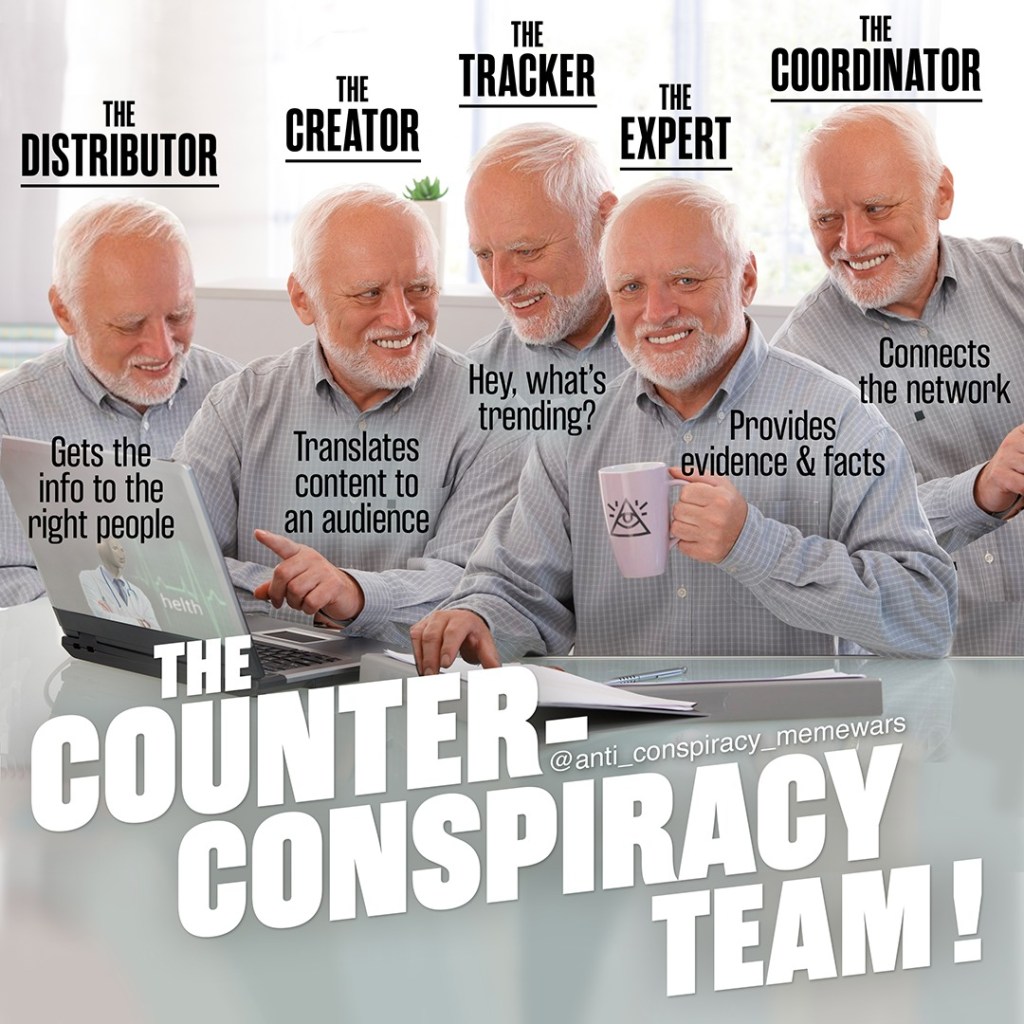
We don’t have to sit by idly.
As Claire Wardle put it so eloquently:

Our information ecosystem is not hopelessly polluted. But we all have to work together to make a change.
-
Anti-vaccination and the Tragedy of the Commons
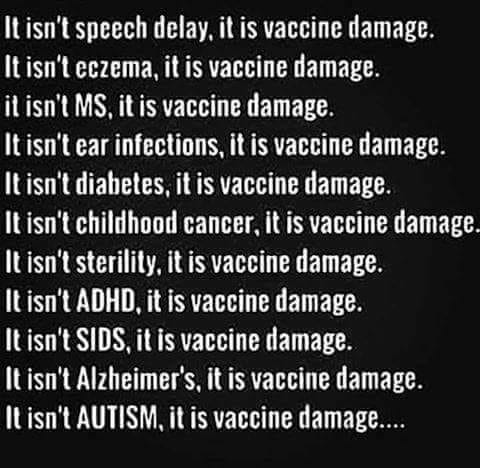
For almost a year now I have been diving in, and have been kicked out of several anti-vaccination Facebook groups. There is an ever growing community of people who refuse to vaccinate against diseases like Measles, Chicken Pox, Tetanus, Polio, HPV,… It’s become so big that the World Health Organization even named vaccine hesitancy one of 2019’s global threats.
I joined these groups because I wanted to learn how people get convinced to refuse something that has become so engrained in society that it’s self-evident. Vaccinations are one of the greatest accomplishments of humanity and modern science. The vaccination against Smallpox (the only disease we are currently officially freed from) is estimated to have saved 5 million lives a year, and we’re on the brink of officially eradicating Polio. Yet people are starting to take a step back on this progress.
I also joined these groups to gain insights for a book chapter on online radicalisation, where I compared the different group architectures on Facebook and Reddit. TL;DR: moderator authority and group openness differ between Facebook groups and subreddits, which I hypothesise makes Facebook Groups more sheltered against counter-opinions, and subreddits more hardened against counternarratives. (I want to emphasise “hypothesise” because I was not able to empirically test these findings)
I’m prone to dive into weird online communities, and I think it’s necessary to share the countless discussions I’ve had, the memes that are being shared and the lessons I’ve learned. It’s important to realize how we’re all going to be fucked if we don’t recognize the very real and serious problem we have on our hands.
CAN VACCINES REALLY KILL YOU?
So let’s start from the beginning on understanding where the anti-vaccination movement gets its fuel;
There are very rare cases where a vaccine caused injuries and even death. This is a very nuanced and complex topic and I’m not a doctor so I’m not going to purport like I have this scientific knowledge. What I found is that it happens, but not as often as antivaxxers think, there is an excellent report on how to read the data of reported deaths following vaccination. From countless online discussions I’ve had, I’ve learned to concede that YES; there is a super duper extremely small chance that an injury was caused by a vaccine. The Auto-immune disease Guillain-Barré (GBS) has a very rare occurance for influenza vaccination of 1 in a Million, Meningitis can very rarely be caused by a vaccine with other environmental factors present (couldn’t find statistics) and of course there are very rare allergic reactions to the ingredients in vaccines. Vaccines can rarely indeed trigger (NOT CAUSE) seizures and make epilepsy surface early in life.
But vaccines do not cause most diseases that are linked to vaccination like ADHD, or Alzheimer or diabetes, and they certainly do not cause autism as is widely believed in the antivaxx community.
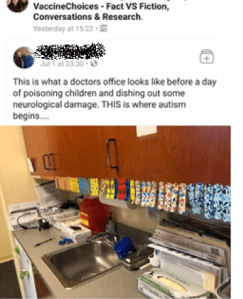
(the doctor’s office is where Autism Begins apparently…)
The Aluminum in vaccines is also not a neurotoxin that will kill children.

(a popular t-shirt in the antivaxx community)
Medical science isn’t perfect, nor will it ever be, but when it comes to vaccines, we have figured it out to a tee. 90% of the medical community are convinced that vaccines are safe and should even be mandatory. That is a huge consensus. But still, freak accidents can happen, and no one is declaring anything 100% risk free. Nothing in life will ever be risk free. That’s why humans are subconsciously constantly doing risk assessments.
False Correlations, Skewed Probability and Fake Studies
Thanks to the internet, super rare exceptions have been granted the possibility to find each other. In a perfect world, only that small group with actual vaccine injuries would be uniting, people with a rare disease finding comfort with each other.

This is however not a perfect world, and our information society is still going through the growing pains of being able to connect with THE WHOLE WORLD.Many people have thus started joining vaccine injury groups that don’t belong there. They claim to have a vaccine injury because of the timing of the occurrence, but rarely have actual proof that the vaccine was the cause. An often repeated mantra in arguing with antivaxxers is that correlation does not equal causation. Just because something happened within hours or days from a vaccination, does not mean the vaccination was the cause. In almost all of the cases, the conclusion is drawn by people, not doctors, that it must have been the vaccinations causing their kid’s paralysis or autisms or even death because it happened right after a vaccination. This belief is so strong it has its own name: the Post Hoc Fallacy. Few of them want to understand that there was an equal probability of something like Sudden Infant Death Syndrome happening on any other day of the year.
Yet to come back to the fact that it IS possible in very very rare cases to cause an injury, it opens the gates of doubts; what if it WAS the cause?
This not only offers an explanation for parents with ill or dead children, It also fuels people’s fear to not vaccinate their children. A simple risk analysis of the actual probability would make it clear however that this should not be a factor to take into account. When vaccine injuries can occur in a hypothetical 1 in a million, at a birth rate of 130 million babies a year, that would not be more than a few hundred yearly worldwide (and I’m being generous with my calculation). Compare that to mortality rates of diseases like measles, which are proven to be 1-3 per 1.000 kids who contract it, and Tetanus which has a mortality rate of 10% of those who contract it, a few hundred in the whole wide world is a negligible risk. In 2017 over 110.000 kids were reported to have died from measles while there was already an 85% worldwide vaccination saturation. That is a lot, to say the least, and will become a lot worse if herd immunity starts failing when vaccine rates drop even more, but we’ll come back to that later.
The probability calculation I just made is what made society convinced of vaccinations in the first place. Risk calculations however change when people’s perception of probability becomes tainted. Right now, the internet offers 1000’s of harrowing stories that are linked to vaccines.

Willingly giving your child a shot for something that thousands of others are telling you will kill your child, that sounds insane, doesn’t it? I’ve found hundreds of facebook groups where people find resonance of their fears not to vaccinate, where these type of stories are wildly being shared, where respectfully questioning this correlation got me censured and banned.
It gets even worse when there are so-called academic studies that ‘prove’ that vaccines are the widespread cause of death or autism. There are numerous articles that do the rounds in antivaxx community, often dumps of information that are impossible to knowledgeably sift through. It’s a common technique of bombarding people with ‘proof’.
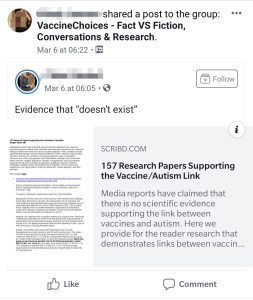
I’m almost too ashamed to admit, but there was even a moment that I started hesitating when I started reading some of those ‘academic’ papers. They seemed to be methodologically sound and were written in an academic way. I was honestly surprised; these weren’t some mommy blogs. Luckily I gave myself a double check. I am not an STEM scientist, what the hell do I know about medical science’s methodology? When doing a more thorough background check on specific studies and their authors, it turned out none of the methodologies survived peer review. Some of the studies in the dumps didn’t actually prove a causal link and were just filler to get to 157 studies, and a lot of them were based on one fraudulent study: the study conducted by the notorious Andrew Wakefield. This infamous study ‘proved’ a link between vaccines and autism, but was later debunked and was never able to be replicated on a larger scale. (If you want to know more, Behind the Bastard podcast does a great history of Wakefield’s corruption and the birth of the antivaxx movement)
There’s a lot more to be said on the fraudulent research bubble, the only thing I want to still highlight is the recurring argument “why aren’t there any more studies comparing non-vaccinated with vaccinated children?”. There’s a simple (yet unsatisfactory for some) explanation: comparing the antivaxx community with another population has too many external factors that cannot isolate the particular impact of vaccinations on the prevalence of incidents. There is no ethical way to conduct such a study in a controlled environment because, well… people die.

Follow The Money you Sheeple!
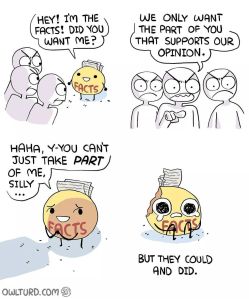
To go back to the crux of the hesitation, we need to understand how people confronted with this information process it. When so many experiences of a vaccine injury are floating around and there seems to be ‘evidence’ to support this correlation, there has to be some truth to it, no? So many people can’t be wrong at the same time??
A lot of people get trapped in the clustering illusion. It is human nature to see patterns to structure reality and find explanations for things that are unclear. This pattern recognition doesn’t always draw the right conclusions, which is how people come up with conspiracy theories.This is exacerbated with the human desire to seek out information that one desires; also called the desirability bias. On top of that, people want to believe information that fits their personal views, also called a confirmation bias. Google and Facebook’s algorithmic filtering are excellent enablers for these biases, which is why Facebook groups are so dangerous (but more on that in another post)
Logical rational calculations are skewed when emotions take over.
“But all those doctors can’t be wrong!”. One part I haven’t highlighted yet: why anti-vaccination theorists refuse to believe the medical consensus. To explain why the medical world has been supporting vaccinations despite such a perceived high risk, antivaxxers constructed a conspiracy theory that vaccinations are being pushed by Big Pharma to make money.

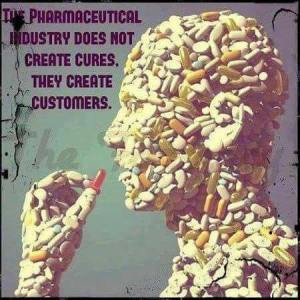
This conspiracy explains for antivaxxers why so many people seem to be dying from vaccines while the medical world agrees it’s necessary. There is definitely some unethical behaviour from the Pharmaceutical industry that needs scrutiny, like their complicity in the Opioid crisis in the United States. But considering the almost unanimous worldwide medical agreement on vaccines, this just does not add up. People will try to find proof for their beliefs, and the internet can provide a support system for those beliefs. It’s a little more complicated than that, but the new information society is partly the reason why there’s currently such a huge increase in vaccine hesitancy.
The tragedy of the Commons
A few people refusing to vaccinate based on this fear would not be such a problem. In a free and democratic society, everyone has the right to choose to make the risk assessment on their own personal health and that of their children. Also, what are the odds on them getting infected and dying?
While the mortality rate of vaccine preventable diseases I mentioned earlier is significant, currently the risk of actually getting infected is very low. This is however not some magical health protection. Antivaxxers are sick of hearing about it, but this is only because of herd immunity.
if 95% of the population is vaccinated, your risks of getting infected are very very low, because diseases don’t spread very far.
This animation ends at 95%, but the percentage actually differs depending on the disease. Measles for example are airborne and can survive for 3 hours outside of a human body. Infection thus spreads a lot easier.Herd immunity is however dropping and local outbreaks in low-vaccination regions are claiming its victims. The infection and mortality rate is exponentially rising in the last few years. As mentioned in the introduction, the WHO has even declared vaccine hesitancy as a global health threat for 2019.
The consequences of these individual decisions are therefore having a massive impact on global health. This is in social sciences also called the tragedy of the commons:
“a situation in a shared-resource system where individual users acting independently according to their own self-interest behave contrary to the common good of all users by depleting or spoiling that resource through their collective action.”
Basically: people are risking the collective health because of their personal risk aversion.

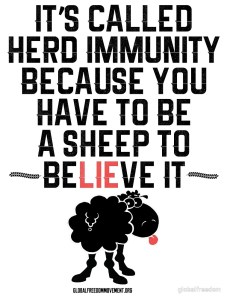
The lack of empathy which is often claimed to be the demise of modern civilization is having an impact on many fronts. A staple figure for this demise is someone like Katie Hopkins, who recently wrote a piece to proclaim how little she cares about the herd because she’s “just not that good of a person” and is not a sheep. (at least she’s honest)
Who really gets the Darwin Award?
I’ve seen vaccine defenders reply that these people should get the Darwin award, that natural selection will weed them out eventually because they will all get vaccine-preventable diseases and die.
While I understand the need for cosmic justice, it’s pretty sad to wish these people dead. The tragedy of the whole situation is also that they likely won’t have any lasting consequences from contracting a vaccine preventable diseases. There are many weaker members of society who will have a much higher probability of dying if they catch a vaccine preventable diseases. Children who weren’t able to be vaccinated because they are too young, the elderly whose immunity has worn off, immuno-compromised people and people undergoing cancer treatment who would be too weak to fight a disease like the measles or chicken pox. And let’s not forget that very small percentage of people who rightfully received an exception because their likelihood of getting a vaccine injury is deemed too high by an actual medical professional.
Cosmic justice will likely not happen for those endangering their whole community.
We’re literally taking steps back from a situation where we were able to protect weaker members of society as a collective. These are now running the risk of dying again because of other people’s choices to believe in conspiracies.

The burning question is therefore: what are we going to do about this?
Quarantines and stars of David
A lot of governments have been alarmed and are starting to bring down the hammer on forcing people to vaccinate. In Europe, many member states are making vaccines mandatory, and EU members already signed a European Vaccination Plan in 2015 to tackle this issue. There are moves happening in some countries to ban unvaccinated children from schools. This is currently the case in California, also called ‘Commufornia’ by antivaxxers ,which introduced an obligation to provide a vaccination proof to enter schools. The state was proven right by the courts, fueling the anger of antivaxxers. As emotions are running high on these government decisions, comparisons are being made to fascist states. Some antivaxxers are even making a statement by wearing the star of David to self-identify as unvaccinated.

Aside the gratuitous comparison, I personally find it enormously odd that those refusing to vaccinated are angered for being denied access to public goods. If one makes a selfish decision over the public good, it would seem to me reasonable that they don’t get to benefit from them. Society will fine and even imprison people for not paying their taxes, Western society started fined people who smoke in closed quarters and endanger other’s health. Why would people endangering herd immunity for selfish reasons not receive any consequences?
It’s hard to talk to people about this without casting blame or push them in the defensive. I’ve noticed talking in an empathic but stern way does help, but I think the whole situation will get worse before it will get better.
My (perhaps pessimistic) prediction is that more people will die before the antivaxxers will adapt their risk assessment. They will slowly start to realize that the odds of their kid (or themselves) dying from a vaccine-preventable disease are far greater than the odds of them getting an unproven vaccine injury. They will start seeing that a vaccination correlating with something that was going to happen anyway (like Autism or SIDS) is not significant compared to the proven cases of kids dying from Measles.
If we do nothing, these realizations will only happen when herd immunity drops and more people around antivaxxers will die of vaccine preventable diseases. In the very worst case scenario, we are bound to wait until the OH SHIT moment kicks in.
Educational intervention
We can accelerate that process of course by improving awareness and empathy. Obviously what we’ve been doing education wise isn’t working anymore. When a lot of people get convinced on emotional grounds and through cognitive biases, education based on authority isn’t viable for everyone; just telling these people what to do because the medical world says so isn’t effective . Studies have shown that it’s not necessarily the uneducated who refuse to vaccinate. Au contraire, it’s the people who have been taught to think critically, question everything and dare to stand up for themselves and say “I’ve done my research!”
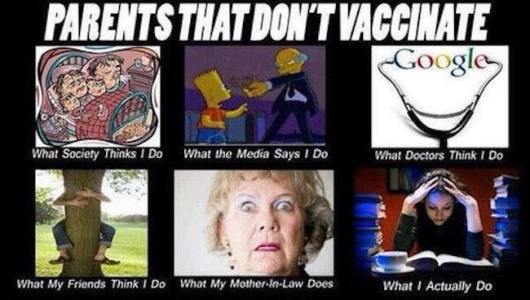
(a meme that shows how antivaxxers see themselves)
As long as the internet provides a place where misinformation can live and fraudulent research survives and even propagates, it is perfectly possible to have ‘done your research’ and come out with stacks of proof that fits your confirmation and desirability bias. There exists a whole parallel information universe where everything about the anti-vaccination narrative makes sense. Not everyone trusts established sources like “the medical world” who say the study is methodologically incorrect. If people don’t trust one authority’s inflictions like “take the shots”, they also won’t trust it when it says “this person or this study isn’t legit”.
Most antivaxxers are highly skeptical people; they won’t do something because there is consensus. They see themselves as going against the current. They don’t realize they’re actually ghostriders. Some even believe they’re doing the world a service by fighting the Big Pharma industry.
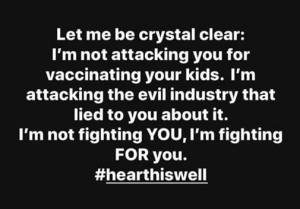
(a post in an antivaccination group)
What can we do, if we would assume a big portion of those critical thinkers is open to reasoning? In my opinion, we can work on improving their knowledge of statistics upon which they make their risk calculation, push back on anecdotical evidence and increase empathy for those at the risk of dying from vaccine preventible diseases. For this we need to:
- Highlight the death toll of Vaccine Preventable Diseases (especially to weaker children)
- Highlight the suffering from Vaccine Preventable Diseases (for example Measles hack the body and harm its immune system for at least 5 following years)
- Highlight the odds of getting infected and how it increases when everyone starts refusing (explain herd immunity properly).
- Highlight the effectiveness of vaccines (they really DO prevent!).
- Counter the post hoc fallacy with a probability calculation (the odds of an illnesses following a vaccination are just as high on any other day of the year)
- Make academic research more publicly accessible and easier to comprehend through trustworthy media resources.
- Make clear who profits from anti-vaccination attitudes (the leaders of the anti-vaccine movement make a ton in selling books and essential oils etc.)
- Highlight the medical consensus
Facts alone won’t make antivaxxers change their minds, as studies have shown that attitudes are much harder to change and are more resilient to factchecks.
As long as information is processed on an emotional level (which it always does, regardless of how rational humans think they are), there needs to be an appeal to antivaxxer’s emotions. Be it reactance (the feeling that someone is taking away choices or limiting the range of alternatives), or solitude (filling the need for belonging by finding community in antivaccination groups), many of these feelings can be resolved by improving mental health and reintegrating people in a broader community.
The Hard Core
There will however always be a hard core that will prefer to look away from the evidence and stay strapped in their echo chamber.
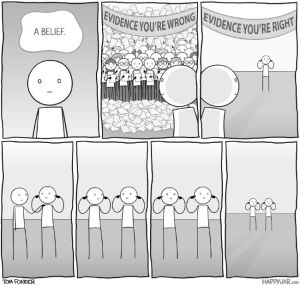
How do we deal with those? Do we allow society to be tolerant enough for these people’s choices? Can we coexist or will we have to oust them from society? Many antivaxxers are already voluntarily splitting off by home schooling or moving to more antivaccination tolerant regions.
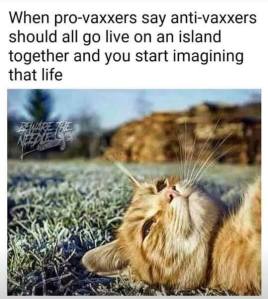
(antivaxxers dreaming of segregation)
This is of course tragic when an outbreak occurs, since it will spread like wildfire in those communities.
It’s something we need to decide as a society how tolerant we want to be. As long as herd immunity is strong enough, we can tolerate their refusal to respect the common goods, as we have always done for that silent minority. But when herd immunity falters and antivaxxers endanger the weaker members of society, it needs to be made clear which consequences their choice has, in the most extreme cases: exclusion from society. I’m hoping we won’t ever have to resort to antivax-stars of David. In a knowledgeable democratic society, everyone should be free to choose, with an appropriate amount of respect for the safety of everyone in our society.
We just need to make sure everyone is truly informed of the risks they pose to themselves and others.
-
Banning online communities; is it too late to stop radicalization?
“Most women who claim they were raped were rapebaiting. If they just let ugly men have sex once in a while, the world would be better for everyone. It’s just sex, they need to get over it”
This was a post from the now banned Subreddit /r/Incels. A community of men who claim to be “involuntarily celibate” because women are evil. One of many, many online communities that revolve around hatred and scapegoating. How is the internet affecting our society and making parallel communities toxic, and what can be done to stop the hatred from festering?
Redditland: population 234 million
A few years ago, I wrote about Reddit’s revolt against the change in management.
I complained about the management’s new direction of banning subreddits, which are microcommunities on one of the biggest online forums. I’ve always been amazed by Reddit’s political structure and it’s reflection of a real society, and I was fascinated how the citizens of reddit tried to reclaim their virtual streets by causing a blackout.
I’m starting to soften on the policy the management took on banning toxic subreddits.
I might even say: I was wrong.I was once saddened how the decision to ban meant that Reddit isn’t allowed to reflect a real society, including all the rotten apples and fucked up people in it. I think the disappointement came from a dark corner in me that grew up lurking on 4chan. I still can’t put my finger on what amuses me to see how people can be so fucked-up, but it did.
I don’t think lurking in the cesspool of the internet ever affected me or my political views since I’m definitely a Libtard. The only remnant is maybe my repertoire of Dead Baby jokes (always a risky performance for a new crowd).
However I sometimes forget that people can be susceptible to, and when exposed enough, convinced of toxic ideas.
I’m seeing it happen more around me now, and am therefore no longer sad with Reddit’s decision to ban toxic communities online.Incels, The_Donald and OneTrueGod
What finally pushed me to change my opinion was the recent ban Reddit put on /r/incels. As shown in the beginning, Incels believe they aren’t getting any sex because they are ugly and all women are superficial and basically “Nazi’s trying to exterminate the male race” by denying them sex. At a certain point they convinced themselves that “reverse rape”— not being allowed to have sex with someone—should be included in the #MeToo conversation.
yeah.
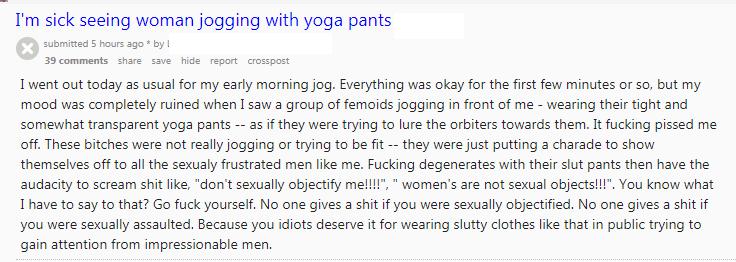
(a typical post on /r/incel, a collection was to be found at /r/inceltears before this sub turned hateful too)
Not only is it one crybaby-fest of men scapegoating women for not giving any sex (newsflash: it’s mostly your ugly personality, not your ugly face), they reinforce each other in their hatred and victimhood. Vice made a great analysis on the indoctrination that was being spread in the 40.000 subscribers strong Incel community, and why ultimately a ban was probably for the best.
Toxic ideas don’t just remain ‘harmless’ online, they infect people’s minds and have consequences in the real world. Extreme examples are shooters like Elliot Rodgers, who killed 6 people, and identified himself as an incel in his manifesto. He was a frequent visitor of Subreddits like /r/redpill and /r/mensrights and is now being worshipped by other incels.
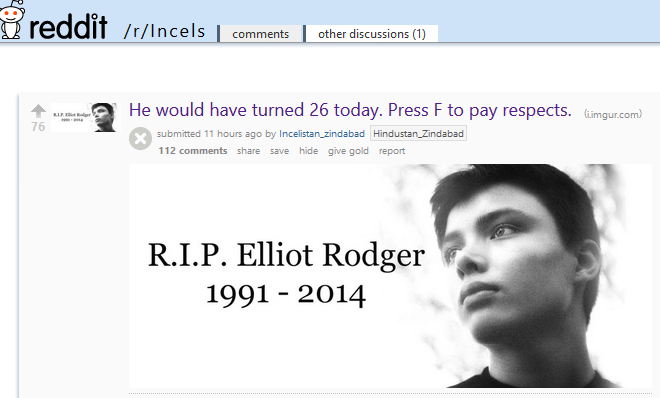
Letting dark communities exist has consequences. This isn’t just about incels or reddit, it’s about the spread of ideas that can be toxic. A subreddit like The_Donald grew as a joke, a bunch of trolls who thought it was funny to defend a racist misogynistic narcissist. They ended up becoming Trump’s online campaign front.
Even before Donald Trump got elected, I read too many stories of people saying they started in The_Donald for teh lulz and thought it was just funny, until they became so involved in the community that they started seriously campaigning for him.

(Donald Trump even gave an AMA, Reddit’s type of Q&A session to /r/the_Donald. Obama did an AMA as well in 2012, only on the official AMA subreddit)
I get it, in some weird way, people can get sucked into things. I’m part of a satiresubreddit /r/OnetrueGod, entirely devoted to Nicolas Cage, our lord and saviour.

It started as a joke, until I noticed I started getting really invested in it. I took a deep long look at myself after I tried to convince my friends to go stalk the hotel Nic Cage was staying in when someone had spotted the one true God in Brussels.
Jokes can get out of hand. and then suddenly they’re president of the “Free World”.
Don’t Feed The Trolls
Is there any argument for banning /r/The_Donald, which supports the legitimately elected President of the United States, except for the fact that they kind of organised their white-supremacy rally in it? If /r/Incels was banned, what makes /r/theredpill any less misogynistic? I’m still very cautious of the concept of censorship. There is the slippery slope argument that if we start here, what will be next? The argument is sometimes used as a fallacy, but we always need to think very deeply what censorship can lead to, especially considering the ban of an entire community.
Doing nothing has proven to have damaging effects though, since the internet can be an effective breeding grounds for radicalization. There have been plenty of actors that saw the immense opportunity in a network of networks, and have used it to further a political agenda. Young muslims who were first exposed to extremist ideas online were a goldmine for ISIS’ recruiting operations. The Mexican (then elect) president Peña Nieto also used recruited trolls who were already dicks on the internet in daily life to spread lies about his opponents and distraction on his own scandals (listen to the awesome Reply ALL podcast on this story)
The Russians have elevated the art of information operations, and use information warfare as a strategic tactic. The invasion in Crimea came with a whole disinformation campaign, and troll armies have been notoriously used to influence the Brexit vote, US elections and have been seen to also influence Czech and French elections.A lot of these operations recruit confused individuals (usually teenagers) and weaponize their frustrations. But not all of the radicalization was steered from some motive, most of it just grew organically out of a certain hatred.
Where that hatred comes from is a whole other question that we won’t delve too deep into. What I usually read is the hatred comes from isolation, lack of community and lack of exposure to a diversity of perspectives.
“Banning an online community will just remove the container”
What should we do then? I’m still not sure banning or censorship is the solution to everything. I always thought people will just find the community or information somewhere else, and you’re basically ignoring the problem. I am however becoming more convinced that allowing a community to fester in its hatred out in the open is not healthy. Banning means the community gets pushed deeper into the web. While we lose oversight and transparency, the toxic ideas also become less accessible, are less normalized, and are harder to stumble upon. It reaches only the most extreme individuals in our society, instead of poisoning a whole generation.
Where do we draw the line though? Are we prepared to give up part of our freedom and compromise on the idea of a free and open democratic society internet? As Karl Popper said in the paradox of tolerance, the only thing we should be intolerant towards, is intolerance itself.
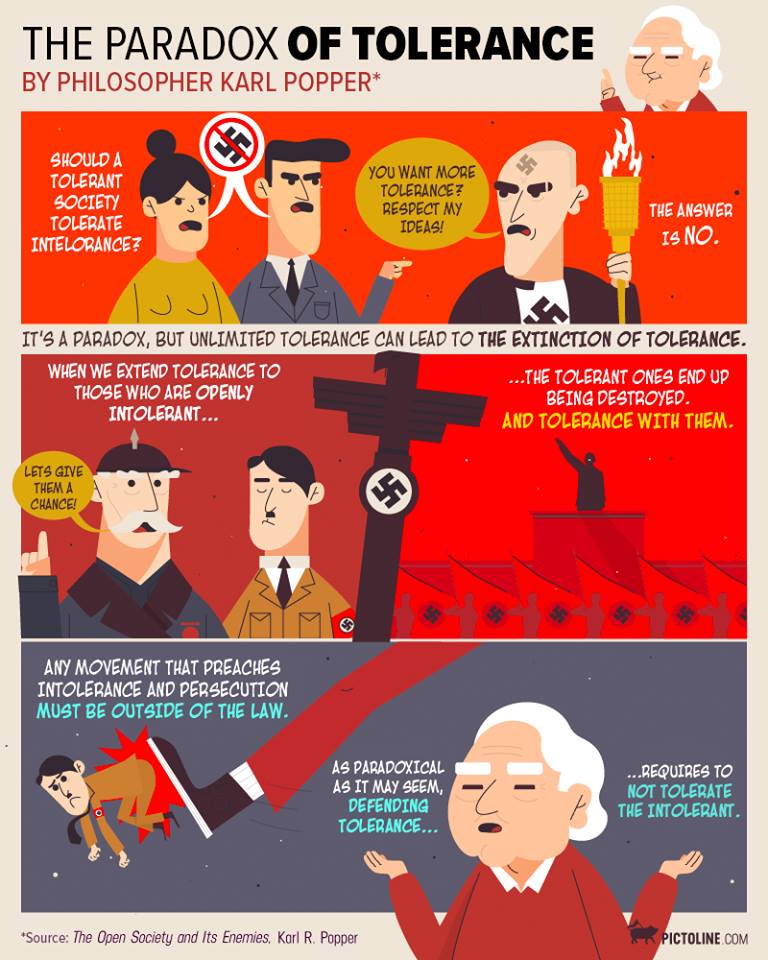
Plato also said this in The Republic, Tyranny evolves from democracy, states stop being democratic when they’ve become too democratic.
Is banning communities the solution though?
Studies have shown that banning subreddits has an impact, and after the first ban of /r/fatpeoplehate and /r/hamplanet in 2015 a lot of the former members of the community slowed down on their hate.
Many didn’t though, which is why banning simply is not enough. Some people don’t just go away when their container of a community is removed, they just take it somewhere else. We need a counternarrative to challenge toxic ideas, and work against the isolation of the communities, so moral borders can be stressed by more outsiders.We’re finally gaining ground on islamic extremism. ISIS seems to be failing to draw as many young recruits to Syria as they used to, and our European societies seem to take steps in reinforcing community and reintegrating radicalizing youths.
The Vilvoorde approach on dealing with youth that want to go fight with ISIS in Syria will always be my favourite example on how to tackle radicalization. Vilvoorde had the highest percentage of Syria-fighters in Europe. Since they implemented the approach, they’ve had almost none.
The set up is simple; if people spot a jihadi recruit, they ask the city for help to gather a roundtable of people who can influence them; family, friends, school, mosque. They try to reconnect the youth with the community, and challenge some of their misinterpretations of the Quran. It’s all based on local trust and love; they invite the youth, but do not force them, to become part of a broader community again.We need to do this for every man and woman that we are losing to hatred. Be it hatred against women, fat people, people of a certain colour or religion, “Social Justice Warriors” but also hatred against white men, and definitely hatred against themselves. We need to learn to spot radical ideas and challenge them. it doesn’t matter if it’s “just online”, these people are as much human online as they are in the physical realm. We need to step up to offer a counternarrative. Make the borders clear, but also make them feel part of a broader community. Kill the “forever alone” trolls with kindness.
Community is important, but if it stays in self-reinforcing bubbles, community can be toxic. Banning microcommunities is a radical solution and a stop-gap measure to healing our society. Let’s hope we can also find a way for the bubbles to open up and diversify the communities people surround themselves with.
Let’s stop people like incels from thinking they’re justified in raping women because they have a right to sex. Let’s change those perspectives.
“The most powerful weapon against the lure of radicalisation is increasing complexity in thinking and developing a critical mind-set from a young age. We have to move away from black-white thinking and try to make young people comfortable with grey”
-
ALL THE FEELS; Godspeed You! Black Emperor’s WWI commemoration set went deep
Godspeed you!Black Emperor played one of the most powerful performances a music collective can bring on Saturday 10th of June, and I am very grateful to have been able to witness it.
Let me set the scene; it’s the 100 year commemoration of the Battle of Messines, significant for being the heaviest non-nuclear detonation ever recorded at the time. The battle was part of the First World War, which took almost entirely place in trenches, in the town of Messines, 10 km south of Yper, in the Flemish fields.
To commemorate, the province of West-Flanders organised a very special night of concerts at the craters where the detonation happened. As dusk started to settle in, the Canadian post-rock music collective Godspeed You! Black Emperor brought us a unique composition, created especially for this occasion.
Now I’m still a novice of Godspeed. This is the 2nd time i see them live, and it’s the 2nd time where they unexpectedly took me through such an intense musical trip. so I can’t say a lot about it being a very typical GY!BE gig. But this composition was a fascinating experimentation, telling the story of this horrible war (“the Great War”’) and its significance by using music and visuals, tying it all together with the historic surroundings.
The concert kicked off with a visual creation by Shelbatra Jashari. Over 100 young people dressed in white hazmat suites climbed the scaffolding on both sides of the stage. The crowd silently watched how the white suites lit up by a video projection, and how names of fallen soldiers rolled over them.
The visuals transformed to contemporary images of West-Flanders, that still contain faint traces from the war. The mine craters dispersed all over the West-Flemish landscape, now rustique ponds. Or with little imagination you could see the soldiers march through those Flemish fields on their way to the frontline. Even visuals of water reminded us of how part of the frontline was flooded to halt the Germans.
When Godspeed You!Black Emperor took the stage, they masterfully made the music swell on, becoming more nervous, agitated, agressive. We felt like we were being catapulted back into the run-up to the war, where emotions were reaching a boiling point in Western-Europe.
When it reached its musical climax, I will bet my left kidney that GY!BE purposefully timed that moment to coincide with the rise of the blood red full moon over the hills, rising ever more powerfully throughout that climax.
(credits: Hugodemoor)
The audience felt it as well, this ever growing presence of the full moon, which was apparently also the eyewitness on exactly the same night 100 years ago.
(credits: Hugodemoor)
Never before have I seen a performance so masterfully use its surroundings to enhance the impact of its music.
The concert continued on, transitioning into a new sort of nervousness. One that felt like a shockwave was reverberating from the tectonic plates colliding in Western-Europe, causing aftershocks in the rest of the world. The music was tumultuous, and you could feel the turmoil in the air. The guided visuals showed prices of food going up in the Commonwealth countries like Australia and Canada, and soldiers from all over the world getting ready to join the battlefront.
I could sense the global aspect of this war even more because of my Irish and Australian compagnions, who also had recollections of what the Great War meant for their country and their history.
The concert steamrolled on, going more into the impact of the war on the human psyche and the individual tragedies. At least that’s how i interpreted it. The snare instruments played a more prominent role, as if they were playing on our heartstrings.
Godspeed gave it their best shot to make us empathise with the deep dark emotions of Fear and Desperation through the music. Guitare snares hit us like bullets, the strings rolled over the Flemish fields like a dark blanket.
Not only sound, but also light pierced the dark night. The 19 surrounding craters flashed the dark skies with some powerful light installations, recreating the constant firing of riffles, cannons and grenades.
(Credits: Babette Van Rafelghem)
Godspeed continued on for a full 2 hour set, sparing no opportunity to bring out all the feels.
Ending with the masterful Moya, the Canadians didn’t exactly end on a cheerful note.
After this intense 2h concert, we felt completely emotionally drained, much like how the people must have felt when it was finally over on November 11th, 1918. But also envigorated by the experience.
The last veteran of the First World War passed away in 2011. He had been 110 years old. There are no more witnesses to WWI to tell the tale, a war that cost the lives to an estimated 9,75 million people.
it’s the type of concerts like Godspeed you!Black Emperor that are needed to help us remember. Let us never forget.
In Flanders fields the poppies blow
Between the crosses, row on row,
That mark our place; and in the sky
The larks, still bravely singing, fly
Scarce heard amid the guns below.We are the Dead. Short days ago
We lived, felt dawn, saw sunset glow,
Loved and were loved, and now we lie
In Flanders fields.Take up our quarrel with the foe:
To you from failing hands we throw
The torch; be yours to hold it high.
If ye break faith with us who die
We shall not sleep, though poppies grow
In Flanders fields.by John McCrae, May 1915
Article also appeared on Indiestyle
-
How the Russians really hacked the 2016 election
The Russians tried to hack the American elections. But not in the way that we’re used to. This piece treats some possible consequences for the West of the information war Russia has taken outside of its borders.
Piece previously appeared on De Morgen on 16/12/2016
In a disconcerting long-read of the New York Times we see all the staggering mistakes made by the Americans so that the Russians could carry out strategic hacks in the run-up to the elections.
Both for hacking the Democratic National Committee and hacking the emails of Clinton’s advisors, there is clear evidence of Russian interference. The Russian state hacker groups Cozy Bear & Fancy Bear, also known as APT28 and APT 29, were recognized in the forensic investigation. The self-proclaimed “lone wolf” Guccifer2.0 who allegedly had committed the hack alone, also made some stupid mistakes making it clear that this was a cover-up of Russia.
Russia’s Information War
The tactics used by Russia here come straight from their information war handbook.
In an information war, information is used for psychological purposes. The goals is to confuse the population with erroneous information and causing unrest with leaked information. The confidence in the traditional sources of information drops and facts can no longer be distinguished from fiction.
The internet is a godsend for this type of warfare, and Russia is perfecting these type of operations.
During the elections in Ukraine and the subsequent annexation of the Crimea in 2014, their use of information operations peaked. They made strategic leaks to discredit the pro-European presidential candidate while distributed fake photographs about Ukrainian soldiers and spreading disinformation (the website Russia Lies collects many of the disinformation campaign on Ukrain)


Russia is also known for spamming internet forums with their Russian web brigades. The Russians have a veritable troll-army whose daily task consists of posting thousands of pro-Russian comments on the web.
Sounds familiar in the run up to the 2016 election?
harmful code vs harmful content
The CIA had already openly accused Russia of these tactics, but the American intelligence community was first putting its effort in an investigation on hacked voting computers.
In the run-up to the elections, it emerged that there were many vulnerabilities in the outdated voting computers. The day before the elections, for example, security company Cyclane showed that it is possible to change the names in a voting computer if you have physical access to them.
Investigating whether the systems had been hacked was a stop-gap measure to restore confidence in democracy and elections. If it could be proven it had not, then maybe the people could trust the election? Sowing uncertainty about the election systems was also part of the information war; making people doubt the results of the election. Such uncertainty is a different way of ‘hacking’ the system, and one that would have definitely had its effect had Trump not won (his voters would have most likely questioned the results ).
The Russians did not have to hack into voting computers to reach their objective, the main goal was always to falter the confidence in democracy, not necessarily to get a puppet like Trump elected.
The US is struggling to recognize that it has a problem of information security.
This has nothing to do with America’s arrogance, but above all with a fundamentally different view of international digital security. The Western doctrine of cybersecurity revolves around protecting (digital) systems, and the information contained in them. Information is no more than a series of zeros and ones.
While the West is only mindful of ‘malicious code’, Russia sees’ malicious content’ as a weapon as well. The psychological weapon of “information operations” as described earlier. It is no coincidence that the Russians prefer to talk about information security instead of cybersecurity. (note: the infosec community also talks about information security, only this term was politicized when explicit demand came for the UNGGE to be called the UN Group of Governmental Experts on Information Security) Influential information is dangerous in Russia’s eyes, and it is not even necessariy to attack any digital systems.
Putin is known for blocking opposition websites and bloggers and actively disseminating lies. A list of lies on the European Union is also kept up to date in the Disinformation Review, a magazine recently set up by a task force of the EU.
It should be no surprise that this vision is share by other authoritarian state like China, Iran, Turkey, where control of information is vital to streamline political preference and keep dissident voices in check.
It seems that Russia’s use of an information operation was not only a way of testing the potency, but also to warn the West of the ‘danger’ of a free and open internet.
A free and open internet: the achillesheel of the West
Now that Putin is also executing his information war abroad; the West has a problem. Freedom of expression is a core value in an open and free society. Unfortunately, this is also the Achilles heel of the West, and the Russians have made good use of it. Not even a long time ago, WikiLeaks was the epitome of free information gathering, holding those in power accountable. In recent months, by distributing only information extracted from Russian hackers, Assange became an indirect spokesperson for Putin.
Trump does not owe his presidency to Putin. There has been some rumbling in America’s lower abdomen for some time. But in the toxic breeding ground of filter bubbles and a post-truth society, there is an opportunity to expand Putin’s sphere of influence. Now that American confidence in democracy has fallen to a low point, the US seems ripe to join the authoritarian states.
The Democrats know that Putin played the game like that. But if they admit that there is a problem with the free flow of information (whether or not such operations have an impact), they might also want to exercise control over all information. One might think they can only beat the Russians in the information war by putting a tighter control on the information in their own country. Following the Reflexive Control Theory, this would be exactly what Putin wants.
The West is already slowly moving in that direction. Counternarratives against radicalisation, restricting hate speech and banning fake news. And how can you be opposed to it, when you see what kind of conspiracy theories are currently finding a platform?
All the signs indicate that we will only go one way: that of a more controlled Internet. With someone like Trump at the wheel, it is not impossible that this control in “the land of the free” will go much further than stopping Russian influence.
The question on my mind is what direction my native Europe will take. Are there means of arming us against the next information war without having to give up our online freedoms?
I do not believe in it, but I sincerely hope that I am wrong.
-
The IoT Zombie army is knocking on our door, what are we going to do about this?
(this article previously appeared on Knack-Datanews)
October 21, the world is confronted with an unprecedented DDoS attack, mostly caused by insecured Internet of Things devices. IoT manufacturers were put under scrutiny, and we were all given a sneak peek of the consequences when we don’t include including Security by Design. Where do we go from here?
The facts: on October 21 a Distributed Denial of Service (DDoS) attack on the DNS provider Dyn caused disturbances on the internet. Dyn is the equivalent of the internet Yellow Pages; they direct you to the right IP address when you type in the URL of a website. DDoS’ing them is therefore a simple, but effective way of making a large quantity of websites inaccessible. No Netflix and Chill, no Reddit, no Twitter. In short, people had to go outside and be productive.
DDoS attacks are as old as the internet itself. When a server is flooded with requests, it cannot reply to other legitimate requests. This happens sometimes when a site becomes unexpectedly popular and has a surge of visitors, but a malicious DDoS attack usually uses infected computers to spike the visitor requests.
A lot of organisations have tried to instill measures to mitigate DDoS attacks, yet this incident was remarkable because of its size. Dyn reported that more than 10 million IP addresses were involved, the equivalent of 1,5 Terrabye per second.
It was discovered that this was mostly possible because of the festering supply of vulnerable internet of things appliances.
Internet of shit
The security community has been cursing for a while now about the Internet of Things, often scorned as the #InternetOfShit. These are all the appliances and gadgets that can (often needlessly) connect to the internet, like your tv, security camera, fridge, but also your car, your toaster, your lightbulbs, your doorlock, and even your bottle of wine. It is estimated that in 2016 about 6 billion appliances are connected to the internet. A dizzying number.
When more appliances are connected to the internet, there are more vectors to infect, which contribute to computing power for attacks.
This was also known by the creators of the Mirai virus, which purposefully infected IoT devices. Millions of infected IoT appliances were thus added to a botnet, creating a monster army of zombies that were used for DDoS attacks, unbeknownst to their owners.
Zombie hideout
A logical step if we want to prevent such attacks in the future, is cleaning up those devices. A lot of users know by now that they need to install antivirus software on their computers, but are not aware that their television or security camera can also be infected and participate in attacks. There is very little motivation for users to do something about this, since the impact of the infection is nearly unnoticeable in daily use.
Every country thus has the responsibility to notify users that show up in the IP logs of recurring DDoS attacks. They can inform the general public, generate awareness, and use certain incentives to secure IoT devices. This way, the zombies can be deactivated and botness can lose their strength.
An IoT that deserves our trust
Unfortunately users cannot do much themselves if they are not even capable of securing their devices. It appeared that Xiongmai, a Chinese producer whose devices was omnipresent in the attack on Dyn, had set default passwords on its devices, that couldn’t even be modified.
This was apparently the case with all devices sold before 2015. This kind of vulnerability is sadly recurrent in many devices. If the password cannot be modified, it most definitely can be controlled by someone else.
Producers are still free to choose how much security they want to install. There is no international security norm for connected devices. Since a cyber-secure connected toaster isn’t exactly a big selling point, this step is often skipped to cut costs.
It is therefore important to call IoT producers to account, force them to have minimum security standards, and penalise those that don’t.
Organisation like the Internet of Things Security Foundation, and volunteers of the security collective I Am The Cavalry are taking matters into their own hands by setting up security frameworks. The latter even managed to make the producers of medical devices swear a hippocratic oath to no longer sell devices that do not have built in security.
The EU is also developing a proposition to force companies to abide to certain security standards, and to find a labelling system for secure IoT devices.
While its certainly useful to secure European production, it lacks some impact in a globalised world. If producers are prohibited to use cheap Chinese components when they don’t abide to those standards, it will be hard to stay competitive. If there’s little knowledge of the issue, few consumers will pay more for a “secured” IoT device.
We need international rules, although it’s not bad to start with a European label.
Too little, too late
When IoT devices didn’t have proper built-in security settings, it’s difficult to secure them afterwards. It’s commendable (and necessary!) that we try to force security by design right now, but it’s actually too late already.
The IoT craze has started a while ago already, and many appliances were sold that can’t install patches remotely. Often users must make a manual firmware update, or even hand in their appliance. Since the lifespan of many of those devices, which are often household appliances, are often only replaced after 5 to 10 years but its users, it’s quite possible we’ll still be living for a while with the consequences of the IoT zombie army.
it’s very pessimistic to say, but this is only the beginning.
-
Is our “Digibesitas” giving us Technophobia?
(This article previously appeared in Dutch on Knack – Datanews)
The tendency to curse smartphones isn’t new. But I am becoming fed up with the articles, cartoons and art that are going for the low hanging fruit of bashing new media technology.
From criticizing the display of personal life on social media and fishing for likes,


to the insensitivity of the “sharing culture”


to being chained to your computer and smartphone


There are too many “wake up Sheeple” cries in popular culture these days, blaming hyperconnectivity to cause society to be anti-social, attention seeking and narcissistic.

I’m showing a bunch of examples in this post that I’ve been collecting for a few months, since they irk me. Like the well-intentioned, but very cringy Spoken Word artist below, who rhymes about how iPhones makes us only think of the “I”.
Even Zenpencils, who I really respected, compares social media to a Heroin Addiction.
(and here’s another such comparison… not so original eh?)
But also more serious voices are riding the wave, like the TED-talk of Sherry Turkle, who is convinced that the virtual connections only make us more lonely.
The Belgian research institution iMinds even came up with a name for the “overconsumption of digital media”: Digibesitas.
It’s starting to feel like Neo-luddism, the Unabomber’s ideology against a new industrial technological society, is back in a softer form. There’s no computer stores being bombed, instead hyperbolic cries try to convince us how society is ill because we’re spending a bigger part of our social activities online.
Kranzberg’s 1st law says “Technology is neither good nor bad; nor is it neutral”. It all depends how it is being used.


“we should all throw away our smartphones maaaaaan, we’re so disconnected”
(I once heard someone say at a dinner-party, that was entirely arranged through a facebook event.)
It would be naive to argue that our social interaction hasn’t changed. Au contraire, the digital revolutions has caused quite some earthquakes, moving all our communication to the digital spectre. As I previously wrote, our memory is even changing due to the possibility of digital storage. It would also be blind not to recognise that there isn’t a sizeable portion of fhe population addicted to social media. There have been countless reports on how algorithms are affecting and steering our behaviour.
But there are also plenty of people who still have a healthy relationship with social media. This pathologizing social media seems to only give one alternative: throw it away.
Some nuance is due on the impact this digital transformation has had on our communication, since there have been plenty of positive aspects of the digital social life.
Digitally enhanced life
Thanks to the sharing culture, we’ve got an incredible archive of testimonies during historic occassions, like the footage during the Paris attacks, the detailed accounts of the refugee crisis, … but also on an individual level, your entire family can easily watch and re-watch the first words of a new addition to the family, or you can watch and re-watch your GoPro filmed escape from a bear that suddenly surprised you in the woods,…
And let’s not forgot movements that were mostly gained momentum through social media such as the Arab Spring or #blacklivesmatter.
Digital communication has made it possible to work from home and take care of your children or a sick family member. There are even so many more possibilities arising to keep doing the same job from the other side of the world, an evolution welcomed by the growing population of tech nomads.
People can stay in touch with friends from all over the world, you can become friends, or even become part of an entire community of people that you’ve never met before. The internet offers an inside look on other cultures for those who cannot afford an expensive airplane ticket.
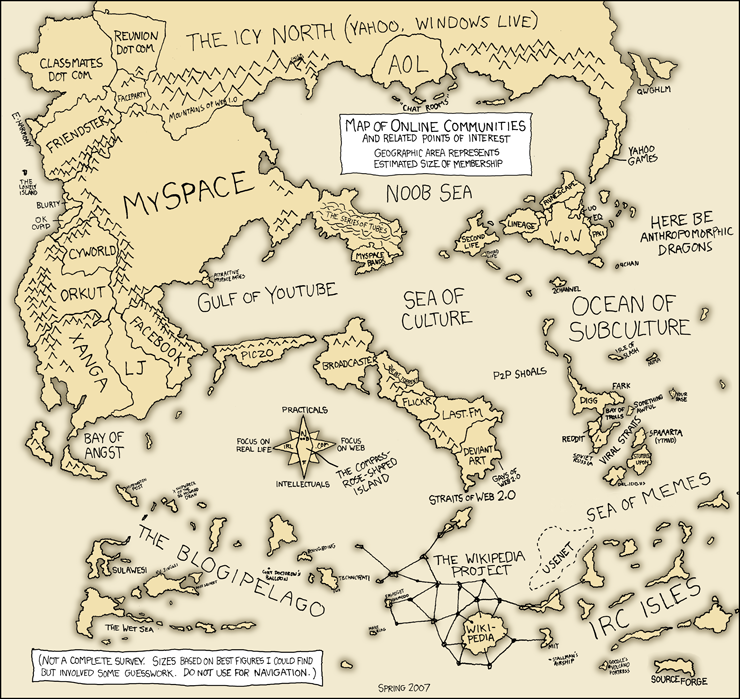
(online communities 10 years ago, in 2006)
Not only has the digital life had a major positive impact on our social life, not taking it seriously can even be harmful.
As Julianne Ross wrote in Wired, the online life is just as real for many as the Physical world. Emotions people have online are just as real as the ones they have offline. Suggesting that it is not, means people aren’t taken seriously in cases of cyberbullying or sextortion.
These are very real problems, that can have an enormous impact on the human psyche.
The biggest problem with the digital society in my opinion isn’t that people are staring too much at screens, but that society hasn’t accepted yet that we are all real people online, with real feelings. Not acting like it can have real consequences (Hong Kong has even noticed a peak in suicides because of cyberbullying). Maybe the presumption that kinds are becoming more narcissistic is because they forgot that every ‘like’ comes from an actual human, and they should cherish it.
The core of my rant is this;
Technology changes, but humans are still human, in digital form.
Anti-social people will just use the tools to stay anti-social and ignore you, possibly retreat to another world.
Young people will always crave attention and validation.
Narcissistic people will always feel like nobody likes them enough, no matter how many hearts you throw at them.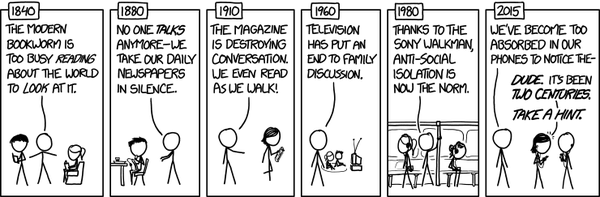
The Digital society has only given us new tools. Tools we use royally, that facilitate and enrich our lives. We still create society ourselves. If this means we’re retrieving more into a filter bubble, it’s maybe becauae the tools give us the possibility to follow our human nature to finding connection. What SHOULD be more central to the conversation is the need for tools that break through bubbles, tools that facilitate discovery. But that is a whole other conversation on how we should reimagine platforms.
In short: yes, the digital life impacts our social interactions. But that doesn’t make them less real.
-
[COLOMBIA] Veiligheid, de grens tussen gevoel en feit.
![[COLOMBIA] Veiligheid, de grens tussen gevoel en feit.](https://nathalievanraemdonck.com/wp-content/uploads/2017/09/img_4124.jpg)
Ik werd thuis veel over Colombia gewaarschuwd. Uitgenodigd door een vriend die in Bogota woont, en nieuwsgierig naar dit land waar ik zo weinig van weet, reisde ik toch af naar het land van magico realismo.
ik genoot intens van de prachtige natuur. Colombia heeft het allemaal, de bergen, de caraibische stranden, de jungle, de woestijn. Ik leerde opnieuw een stukje van Zuid-Amerika kennen, als een puzzelstukje dat werd toegevoegd aan mijn Latino-puzzel. En natuurlijk sprak ik dus ook weer met veel mensen op mijn (korte) trip.
De Colombianen vinden hun land zelf echt de moeite waard, maar vinden het toch altijd nodig te vermelden dat het een gevaarlijk land is. Een jarenlange geschiedenis van guerilla’s, narcos, militia en woekerende criminaliteit hebben het collectieve geheugen van de gemiddelde Colombiaan aangetast.
Wie ben ik natuurlijk om een local tegen te spreken, maar die paranoia moet toch met een korrel zout genomen worden. Ik merk na een tijdje reizen dat je niet altijd de angst moet geloven die de locals jarenlang gevoed is.
Ik merkte dit al in Brazilië, waar een vriendin in een auto met kogelvrije glazen rondreed, en een andere nooit in het donker de bus pakte. Angst komt altijd van ergens, en waar rook is, is vuur. Eigen ervaringen, of die van hun vrienden hebben hen in die positie geduwd. Het feit dat Braziliaanse, en Colombiaanse media erg gefocust is op het verslaggeven van misdaad in het land, draagt ook niet bij aan het algemene gevoel van veiligheid.
ik wilde echter niet enkel als tourist hun land ervaren, of met de upperclass in hun kogelvrije glazen rondrijden. Ik wilde ook gewoon over straat kunnen lopen en een glimps krijgen op de realiteit van de gemiddelde Colombiaan.
Mijn Colombiaanse vrienden vonden mij naïef wanneer ik HUN comfortzones verliet. Natuurlijk liep ik gevaar door in bepaalde wijken rond te lopen. Als overduidelijk gringa ben ik een easy target, een toerist die waarschijnlijk wel geld en een camera op zak zal hebben. En de kans dat ik beroofd word is reëel.
Maar door de plekken te vermijden waar zij niet naartoe durven, lopen ze zoveel mis. Een andere realiteit die ze niet onder ogen komen. Een wereld vlak naast hun deur die ze nog niet bezocht hebben. Wijken die meer zijn dan hun stereotype, waar ik super warme en hartelijke mensen ontmoet. Dat mis je allemaal als je uit voorzorg maar wegblijft.
BRUSSEL
De reden waarom ik dit zo belangrijk vond, was niet om mijn vrienden op hun plaats te zetten, en moeder Theresa in hun land te komen uithangen. Ik zag gewoon gelijkenissen in hun gedrag met hoe Brussel wordt gepercipieerd momenteel. De terroristen hoofdstad. Waar nu niet alleen Belgen zo’n slecht beeld van hebben, maar de hele wereld. En dan vooral Molenbeek, die wijk die ontegensprekelijke slechte kanten heeft.
De wereld is niet zwart-wit, en alles heeft ook zijn goede kanten. Mijn Brussel, waar ik ook uren enge verhalen over kan vertellen, slechte dingen die mij of kennissen er zijn overkomen. Berovingen, geweld, verval en wanbeheer. Maar waar ik tegelijk ook hartstochtelijk mijn hand voor in het vuur zou steken om het te verdedigen tegenover buitenstaanders.
Het doet me ongelooflijk pijn wanneer mensen uitspraken doen over Brussel zonder het zelfs gezien te hebben. Zonder het te ervaren. in de chaos van deze stad ontstaan zulke mooie dingen, en zitten zoveel mooie mensen en verhalen.
Dit ervaarde ik in Colombia ook toen ik in Comuna 13 rondliep, een wijk in Medellin die jaren kampt met een slechte reputatie.
De bewoners waren zelfs verbaasd over onze aanwezigheid. 4 vrolijke buitenlanders die rondliepen in hun kleurrijke wijk wijk.
Iedereen groette ons hartelijk en vroeg waar we vandaan kwamen.
Een dame op straat begon met ons te praten en nodigde ons uit in haar huis. Ze wilde ons voorstellen aan haar dochter, ongelooflijk trots dat wij, uit Belgie, Duitsland, Canada en de VS haar wijk kwamen bezoeken. We kregen een glaasje frisdrank en kletsten in gebrekkig Spaans met haar.
We zeiden haar hoe kleurrijk de wijk is, en ze schaamde zich dat haar wijk bekend staat in de rest van het land als “een van de meest gevaarlijke plekken van Colombia”. De beruchtheid mede veroorzaakt door een reportage die gemaakt werd over haar wijk enkele jaren geleden.
Terwijl de wijk zoveel verbeterd is in de voorbije jaren. Maar geen Colombiaan die dat gelooft.
Medellin investeerde onlangs in roltrappen in de wijk, zodat bewoners zich gemakkelijker kunnen verplaatsen in de steile wijk. Tevens een reden voor bezoekers om Comuna 13 te bezoeken, en de buurt te openen naar buitenstaanders toe.
Deze mensen, en de mensen van Molenbeek verdienen geen schaamte. Integendeel, ze moeten versterkt worden in hun waardigheid en trots om de wijk beter te maken. Want verandering komt vanbinnenuit. En waardigheid geef je door hen kansen te geven, zoals Medellin doet.
Ik zeg niet dat de gebeurtenissen waarop men zich baseert niet waar zijn, of dat er geen criminaliteit in Comuna 13 is. Ik zeg ook niet dat men opzettelijk gevaarlijke wijken in moet lopen om een punt te maken.
Veiligheid is een gevoel, dat gebaseerd is op feiten. Gevoelens kunnen echter ook gevolgen hebben voor die feiten, en de veiligheid alleen maar erger maken. Dat heet dan een self-fulfilling prophecy.
Wanneer een plek in de vergeetput geduwd wordt, zal het ook geen moeite doen om zich te verbeteren.
Het is nooit productief een wijk met al zijn bewoners te demoniseren. Praat met hen, en behoudt een open blik.
-
Digital Amnesia
(This article appeared earlier on Vice: The Motherboard NL)
With all this talk about ‘digibesitas’, let’s add one more new-society disease to our vocabulary: Digital amnesia. It’s the act of forgetting certain things when you store them on you digital devices.
I started to notice that my memory is failing me lately, and it’s was really beginning to frustrate me.
Remembering the street that I had just looked up, or the name of that movie, with that actress, you know, who was together with that guy, but I can’t remember any of them… It seemed I had to rack my brain much more to remember the stupidest things, and I couldn’t limit myself to less than 10 internet searches a day for these stupid kind of things.
Early onset Alzheimer
When I couldn’t even remember the pin code of our shared food-account at the
 supermarket counter at rush hour, and had to look it up in the notes of my phone cause I knew I had put it there temporarily ‘just in case’, I went to the doctor.
I dead-seriously asked him if Alzheimer is possible at my age and he looked at me and said “Nathalie, go to sleep earlier”.
If he wouldn’t take me seriously, the internet would, so what did I find on one of my nightly internet-rounds? That we’re all collectively kind of worried about our memory.
Scottish researchers diagnosed this memory loss a few years ago as the ‘Busy Lifestyle Syndrome’. According to their theory, our capability to remember isn’t decreasing, but we just have far too much to remember these days. Therefore some recollections disappear in the realms of our brain, buried by the avalanche of information.This is only half the truth. In order to cope with all this information piling up on us, we try to save a lot externally. Our smartphone has become our biggest ally, but it also adversely seems to be the cause of our memory loss.
A recent study initiated by the cybersecurity company Kaspersky Lab speaks of ‘digital amnesia’. This entails the phenomenon where you will start forgetting information after you’ve entrusted it to your digital device.
Your brain will stop putting in an effort to remember certain bits of information, since it knows those are being remembered somewhere else.
The only knowledge it still retains is the instructions where to find said information.
Your brain becomes a directory to where certain files can be found on your smartphone/computer/the internet.As if you’re asking your brain “hey buddy, can you tell me where Ann lives again?” and your brain is this lazy slob lying on the couch watching tv, yelling “she mentioned it somewhere in this facebookconversation you had a while ago. Try searching with keywords ‘party’”
According to the Kaspersky study, more than half of its respondents will think of keywords to Google the answer, instead of thinking of what the answer might be. This is also called ‘the Google effect’.
The joy of forgetting?
Our cognitive processes are truly changing when the internet and smartphones are within arm’s reach, it seems. According to Maria Wimber of Birmingham University, these devices allow our brain to ‘selectively forget’ the externally saved information to make room. Forgetting is quite healthy for our brain, and when we save that info on an ‘external brain’, we feel safe and assured that forgetting won’t mean that info will be lost. We can now make space in our head’s hard drive and process more new information.
So far the good news.
Because what if you suddenly don’t have your external brain with you? What if you need some important information that you hadn’t remembered because you counted on that smartphone?
Your data running out when you still needed to look up the route to your friend’s house.
 Missing your last bus when your phone has died, and not remembering a single phone number from the top of your head to help you out.
Not remembering the name of that grey white man that is walking enthusiastically towards you at a conference, and you can’t quickly check your linkedin.
Or even worse, when your brain accidentally deleted the directory to some information because there’s too many storage spaces. That article I was going to reference to, did I save it in my bookmarks? Did I put it in my Evernote? Did I e-mail it to myself? What keywords can I use to google it and find it again…
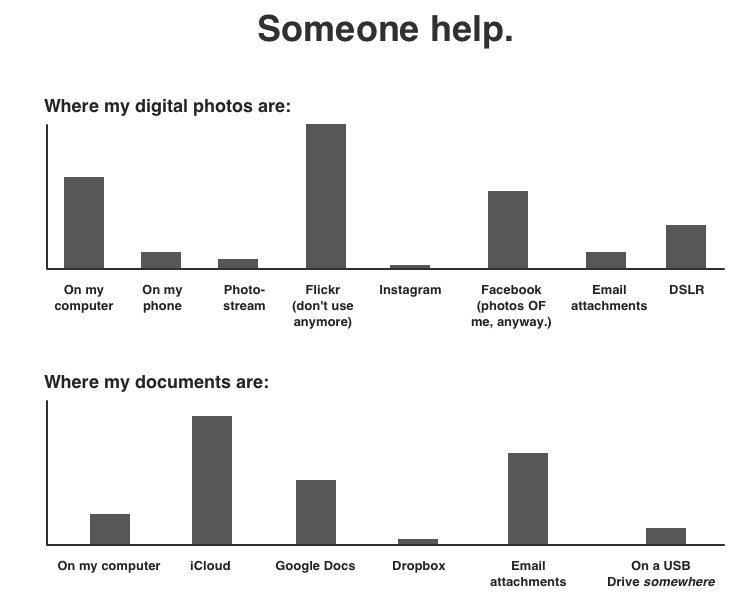
(Courtesy of Doghouse Diaries)When the external brain disappears…
We unknowingly put so much trust in our devices because they are so efficient and user friendly. It almost makes us forget that they can disappear in a single moment.
You can lose your device, but also your back-up can disappear.
Whether it’s mechanical failure or magnetic field breakdown, back-ups on hard drive will not live forever. You will need to refresh them at least once every 3 years to make sure the data stays safe. After some more years, some of the files on your hard drive might also become unreadable because of ‘bit rot‘. Vint Cerf, the ‘father of the internet’ warned us for this phenomenon. Some files are only readable by certain programs, and those would no longer be supported by newer computers. You would still have the file, but no way to open it. (This colourful mess is all you’ll be left with)
And the internet itself is disappearing and forgetting all the time to make space.
I recently made the painful discovery that my unused Hotmail-account, my very first e-mail address that I had created when I was 12, was completely empty.
Microsoft had made a big sweep of inactive accounts to create more serverspace and clean up its data storage.
Gone were my stupid but funny teenage e-mail chains with friends. Gone were my very first digital love letters with crushes. Gone was all this information that I will never retrieve again.This happens all the time, since the rapid growth of the internet also means an ever expanding amount of information that occupies server space and overwrites other data. Who knows what part of the internet will stand the test of time.
If we’re not careful, it is quite possible our collective digital legacy could go up in smoke in less than 50 years. It’s one of the reasons I donate to the Internet archive and its waybackmachine. Webpages disappear all the time when their owners stop caring about them.
One can say we’re at a point of no return, the internet and our devices have become an extension piece to our brain. We can embrace it, continue processing new information and rely on our external devices to remember it. And accept it might one day be lost.
We can try to fight it and try to remember everything to the point that it drives us mad. Print out all pictures and documents to keep in a box in the attic. Make 6 back-ups and store them a tin jar to protect them from solar flares and spread them over the globe.
But it doesn’t matter what kind of wonder pills you’ll try to take. One day we’ll all forget, and be forgotten.
-
Balkan Roadtrip: Slovenia, Bosnia, Croatia

As usual when I write about my travels, my posts are riddled with anekdotes of the trip as well as observations and insights on the countries and cultures I visit.
I’ve been wanting to visit former Yugoslavia for a while since it’s such unknown territory, so I gained a lot of insights. It made me realize how little I really knew about the Yugoslav war and the Balkan in general.Slovenia
My friend Emilie and I started our trip in Slovenia to see my friend Rok again, with whom I had studied in Amsterdam. Katherina, another study friend who lives in Germany, had joined us in Ljubljana as well for the occasion.
Rok was an excellent tour guide and immediately plunged us into Balkan mode with his “favourite” collection of Slovenian Eurovision entries on the road to his house. He also treated us to some crazy ex-Yugoslavian music over the weekend, highlights being the genre “turbo-folk” and a band called Laibach, who are now playing in North-Korea as the first foreign band to ever perform in the dictatorship.Rok showed us Ljubljana the next day, being our personal tour guide, and we learned that Slovenia basically invented democracy. It was a gorgeous little city, not too overrun by tourists yet, and its city logo is a dragon. A DRAGON. How badass is that?

Ljubljana had apparently also always been kind of a rebel, resisting to the many occupations the city had gone through.
There were also a lot of Austrian influences to be noted in the city’s architecture, very pleasant to the eye. When the rain started again, we fled into the modern arts museum, where a little performance was planned at closing time. This resulted into us listening to the most famous Slovenian artist preaching for 45 minutes in Slovenian while we lied down staring at projections on the ceiling. Apparently the artist is a really cool dude, who performs a play every 15 years in zero-gravity. Dragan Živadinov’s goal is to perform the last reprise in 2045 in outer space. Damn! If only I understood Slovenian…
On Monday we left to pick up our rental car at the airport to start our roadtrip. We were told the Bosnian roads and drivers were really bad, so we expected the worst. Turned out the next day we had been worried about nothing and Bosnia was a breeze to drive. We also entirely relied on the roadmap we brought and the signs on the road. Not having to use the GPS felt quite liberating really.
Bosnia
It was instantly noticeable we were in a different country when we stopped for our first toilet break. “you cannot use toilet here. There iz no woter. No woter in region for last days”.
A few kilometers further, there was still no water, but Emilie was told in Bosnian sign-language she could use a little bit of the brown bucket water to flush the toilet.
We weren’t comfortable to pee on the side of the road since we had been told there were still landmines everywhere in Bosnia, especially next to roads. We were definitely in a different part of Europe.Islamic Bosniaks and the War
From the moment we drove into Bosnia, we were taken aback by a sight we had never before experienced in Western Europe: minarettes of mosques riddling the landscape!
When the Ottomans conquered the area 700 years earlier, they had spread their religion, still popular to this day. The Bosniaks (Muslim Bosnians) make up 44% of the Bosnian population to this date so of course the presence of Mosques was as normal as church towers in our landscape. The Bosniaks were sadly enough heavily persecuted during the Yugoslav war 20 years ago, in which Bosnia was the main battlefield.
We all heard about the war, but most of us don’t know the details of it all, why it all started, and why it ignited a genocide against the muslims. I didn’t get to the bottom of why Muslims were so hated while we were still there (but is there ever really a reason?), but I would highly recommend to watch BBC documentary series “the death of Yuguslavia”. I taught me a lot about the run up to the conflict, the political powerplay and how it could escalate so badly.It was kind of a weird realization that Islamophobia was just as prevalent in these regions as it was in our Western-European society. Only here the Muslims weren’t immigrants that could be told to “go back to their own countries with their own customs”. Muslims had been here for centuries!

(Water fountain in a small Bosnian village on our route that had Arabic inscriptions that were several hundred years old)
Muslims had always lived together in peace with Catholics, Orthodox Christians and Jewish (who were unfortunately almost entire driven out during the 2nd World War). A lot had changed over the last few decades though, and even 20 years after the war, ethnic tensions were still there. We met a backpacker who was in the mainly Serb-controlled parts of Bosnia (Republica Srpska) who saw the outspoken hatred against Muslims when he walked around with a Pakistani backpacker. Obviously the rivers between the ethnic groups still run deep.
Driving through Republica Srpska we saw that most of the signs were in Cyrillic and Latin alphabet, but the Latin letters were often spraypainted away. And the reverse happened when we left Republica Srspska, the Cyrillic intended for Serbs would be erased, as a clear sign who doesn’t belong there.
We were told that, to cool things down after the war, the three main ethnic groups of Serbs, Croats and Bosniaks were given their own political rights and their own president through the Dayton accords. Sadly enough, ONLY those three are represented, but there’s no representation or even administrative definition of Jews, Roma, Atheists,… Our guide in Sarajevo told us, if you request the Bosnian nationality and your parents happen to be Catholic, you administratively become a Croat, even if you’re not from the region, because that’s how the Croat’s identity is defined. There was a European court of Human Rights decision about the unfair division of power to only those three ethnicities, but apparently nothing changed.
Such a weird system…
I shouldn’t go too deep into the politics of Bosnia, they’re far too complicated and I am myself a novice at understanding it. I’ve just learned that identity in Bosnia is a hypercomplex concept (at least for me it was, I had a hard time grasping it) and the idea of accommodating ethnicities through politics is a very rocky road in a country with centuries of changing identities and a war started by nationalistic feelings.
Between the political questionmarks popping up above my head, I also really enjoyed the Bosnian countryside. We stopped at a village called Jajce, which really impressed us with its inconspicuousness. A gigantic waterfall practically fell out of the city, and there was almost no mention in our guidebooks!

The country is truly beautiful, and should not be overlooked by nature lovers. I am quite sure if Bosnians can properly process their trauma’s and start rebuilding the country, they could become the tourist hub Croatia turned into. Sadly enough, we were told too many people are still too broken to work on tourism, and it’s understandable they still have different priorities. I’m sure the next generation can fix this, if only they can recover from the scars of their parents.
Sarajevo
Driving into Sarajevo proved to be a challenge. Not only because we were staring our eyes out at the war torn buildings, the mass graves on the hills and the Olympic remnants of the golden times of Yugoslavia.
But also because we made the mistake of relying on the GPS again. The camping owner had sent us directions for a different road to his camping on top of the hill and advised us not to follow the one on the GPS. After 3 tries and difficulties finding his directions, we gave up and turned on the GPS. It led us through the traffic infested centre of Sarajevo, and through ridiculously steep and small village roads up the hill. I drove up in 1st gear, with a howling engine, dodging pedestrians all the while fearing any opposing traffic on the tiny road with 30% inclination. We would have almost made it entirely up the hill, were it not for a car parked at the end of one of the steepest roads. When the car got out of the way, it proved to be impossible to start our car again on the hill. With the car still gently rolling down the hill after the handbrake had given up functioning, we backed into a little resting space and pleaded to the Bosnians that had blocked the road to get us out of here.
(we noticed when we went back to the hill later that it said “welcome to the Ghetto” on the side. the Irony.)
The Bosnians dropped us off with a comment we interpreted as “your tourists got stuck again!” but the camping owner welcomed us with open arms. Camping Olywood was basically the backyard of Oliver’s house, and the atmosphere felt a lot less formal than most campings. We chilled in his house with some local beers and heard many stories about the war.
The next day we descended from the hill to explore Sarajevo. Also called the Jerusalem of Europe, Sarajevo is a very unusual melting pot and it was difficult to believe we were still in Europe. The little streets riddled with shops and arab ornaments made it feel like we were in Istanbul, or some kind of Turkish Bazaar.
From one street to another we were back in Western Europe, with H&M and Zara and cocktail bars.
You’d almost forget this was also the place where Franz Ferdinand was murdered, igniting the fire to the First World War.
The most recent history was still very visible, and it was apparent in a lot of areas that city was under siege for three years. Sniper fire and shelling had been part of the daily routine for all Sarajevans.

We learned that the Sarajevans wanted to be as normal as possible during the war. The owner of our camping opened a club during the siege of Sarajevo. “We tried everything to keep a feeling of normalcy, and it was our way to say “Fuck You” to the war”. He also talked about how he helped organize the legendary U2 congress in 1997, when the war was officially over. It was all an attempt at going back to normal, though 20 years later we didn’t feel like the city had fully recovered from the war. People still seemed very scarred, and restoring all the buildings and hiding the bullet holes was the last of their priorities. The national museum was closed for lack of governmental funding, and the historic museum that recounted the Yugoslav war was struggling to survive. The employees of the historic museum told us they kept working with minimal pay, no heating in winter and the building falling apart. A shame really, because the museum tells the amazing story of daily life during the siege of Sarajevo, in which 10.000 Bosnians died.
All in all, the air was thick with the amount of history this city possessed.
One and a half day was definitely not sufficient to grasp the complexity of Sarajevo, and both me and my travel companion decided we should definitely return one day to ponder the city more.
Mostar
We continued on to Croatia, with one last stop in Bosnia, visiting Mostar. Mostar is famous for its historic bridge that had been there for centuries, which was brutally blown up during the war. It was restored with UNESCO money, and turned into the main attraction point for tourists, with guys jumping off the bridge into the water and demanding money for their stunt.
Again the GPS failed us when we were instructed to drive onto that small historic bridge, sprawled with people, and with steps before and after the bridge -_-
Mostar also had a lot of battered buildings, and had been one of the main battlegrounds between the Croats and the Bosniaks. Tensions were still not entirely over, and apparently the city still has a separate bus station for Croats and Bosniaks.
Fistpumping in Croatia
When we continued to Croatia, we were greeted with the glistening Adriatic sea, an Ibiza beat and beach resort vibe. It was all a tad too weird, coming from a really intense trip through Bosnia, to land at this naive coast, filled with flipflop-wearing, cocktail slurping, suntanning party people.
Finding a simple, nice and quiet spot on the beach proved to be impossible when we couldn’t find any parking spots. We very quickly decided it’s no use to try finding a spot on a beach in little towns, and continued to drive along the coastline. Emilie had a very good eye for spotting semi-hidden beaches on the side of the road, and we managed to cool down in the water without having to fight for every square cm of shade on the beach.

Even though we were only in Split for an evening, I was impressed with the well preserved ancient-roman city centre. The very narrow streets used to be part the palace of Diocletianus, who was once the emperor of Rome. the streets were later occupied by the citizens when the barbarians came, and it did feel like people actually lived in the city. The delicious sea-food and Italian inspired pasta’s were also a feast to our mouths after all the meat and our own shitty camping cooking we previously relied on.
Our last visit was the historic beach town of Zadar. Entering Zadar, we saw the familiar sight of bullet-ridden buildings again. It was a rare sight in Croatia, most of the war-plagued buildings in Croatia had been renovated and restored. Croatians had left the war behind and their coastal line was now the place to be for parties.
Zadar had also two of the coolest art installations; A sun greetings-disco floor

and a sea organ, that made music with the patters given by the sea. We sat there for very long, pondering which songs the ocean had already composed on this organ.
On our drive back to the airport, we couldn’t resist to stop at Plitvice lakes, which was on our route home. We “Nope”d out of there as fast as we could when we saw the packed crowd at the ticketline.
A last picknick in the woods would suffice we said. Parking our car not too far from the lakes, we walked into the forest and suddenly noticed we had entered the park… oeps! While we unpacked some food and sat on some rocks, tourists would pass us by and stare as if they had just seen 2 mountain goats picknicking on a mountain.
Splendid ending to this trip, was what we both thought.

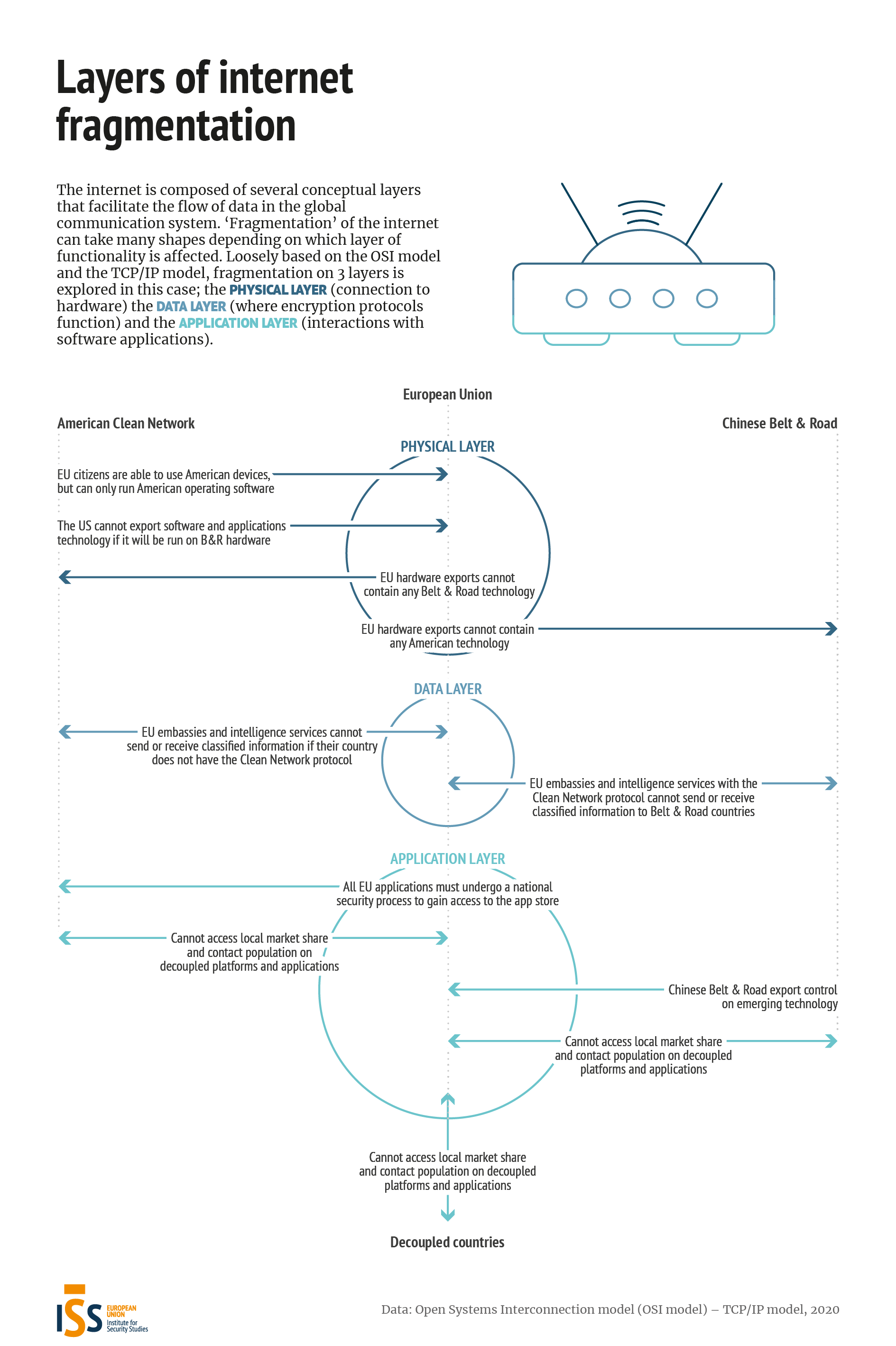
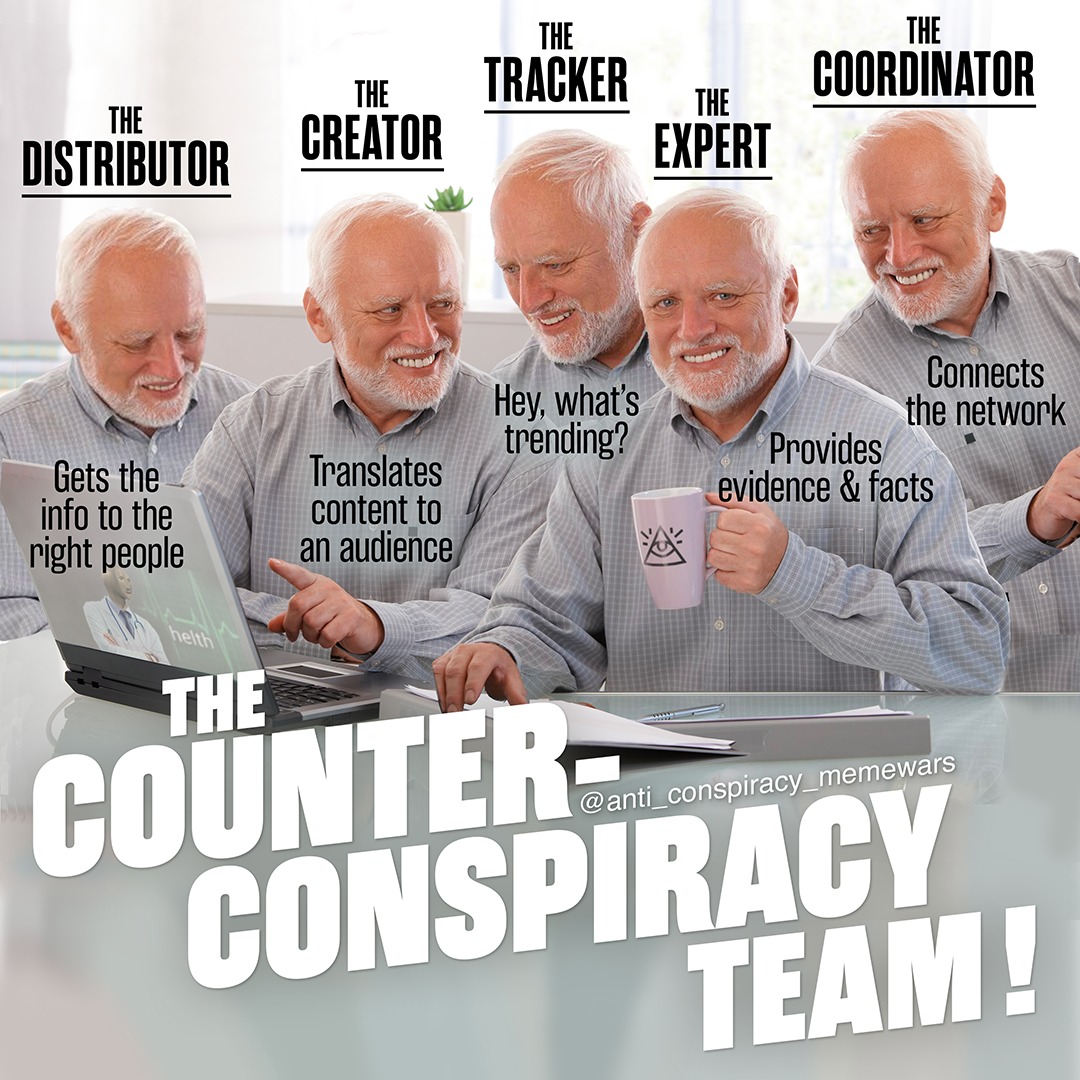
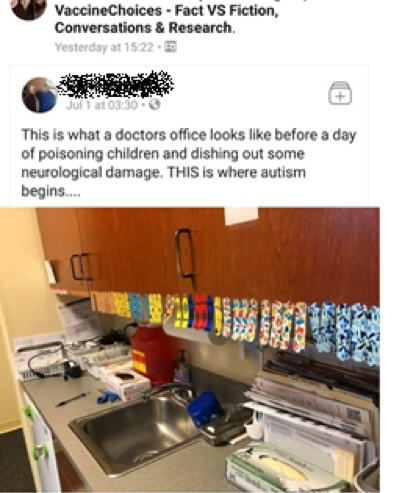
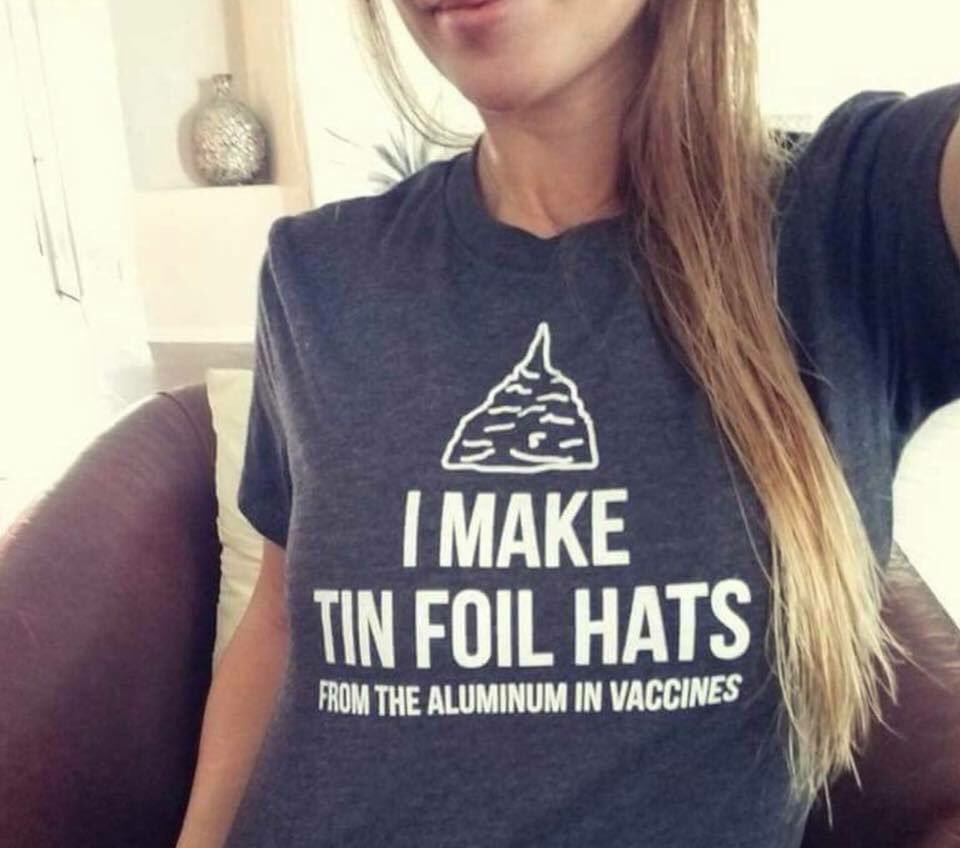


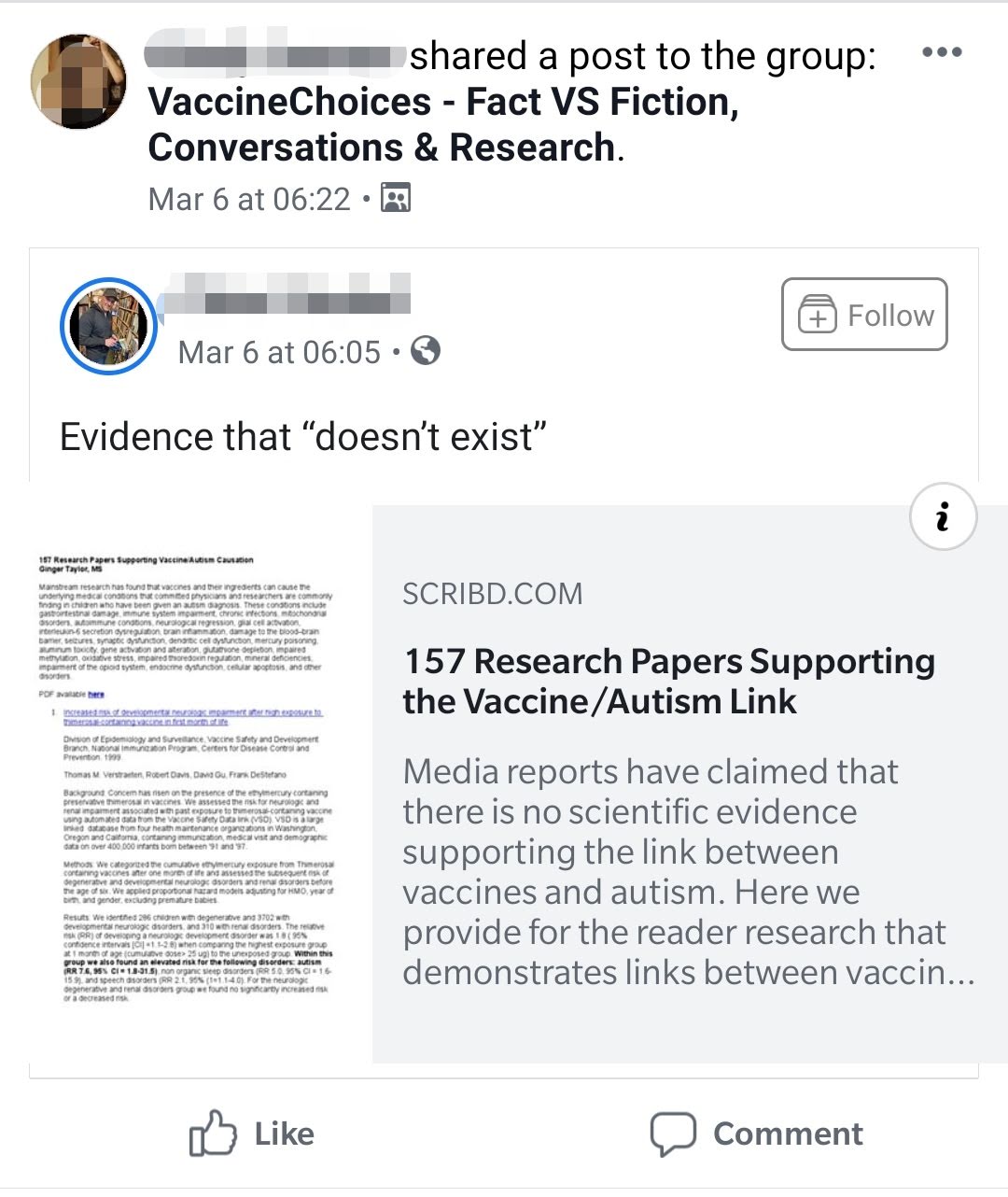

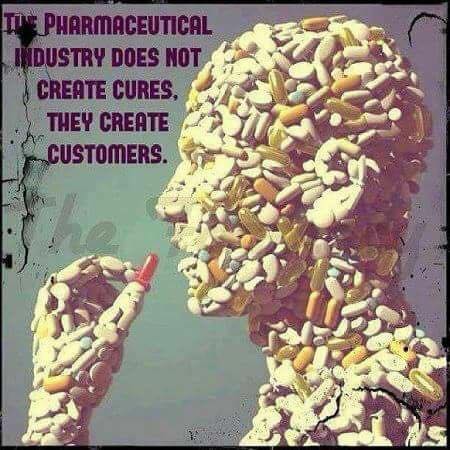
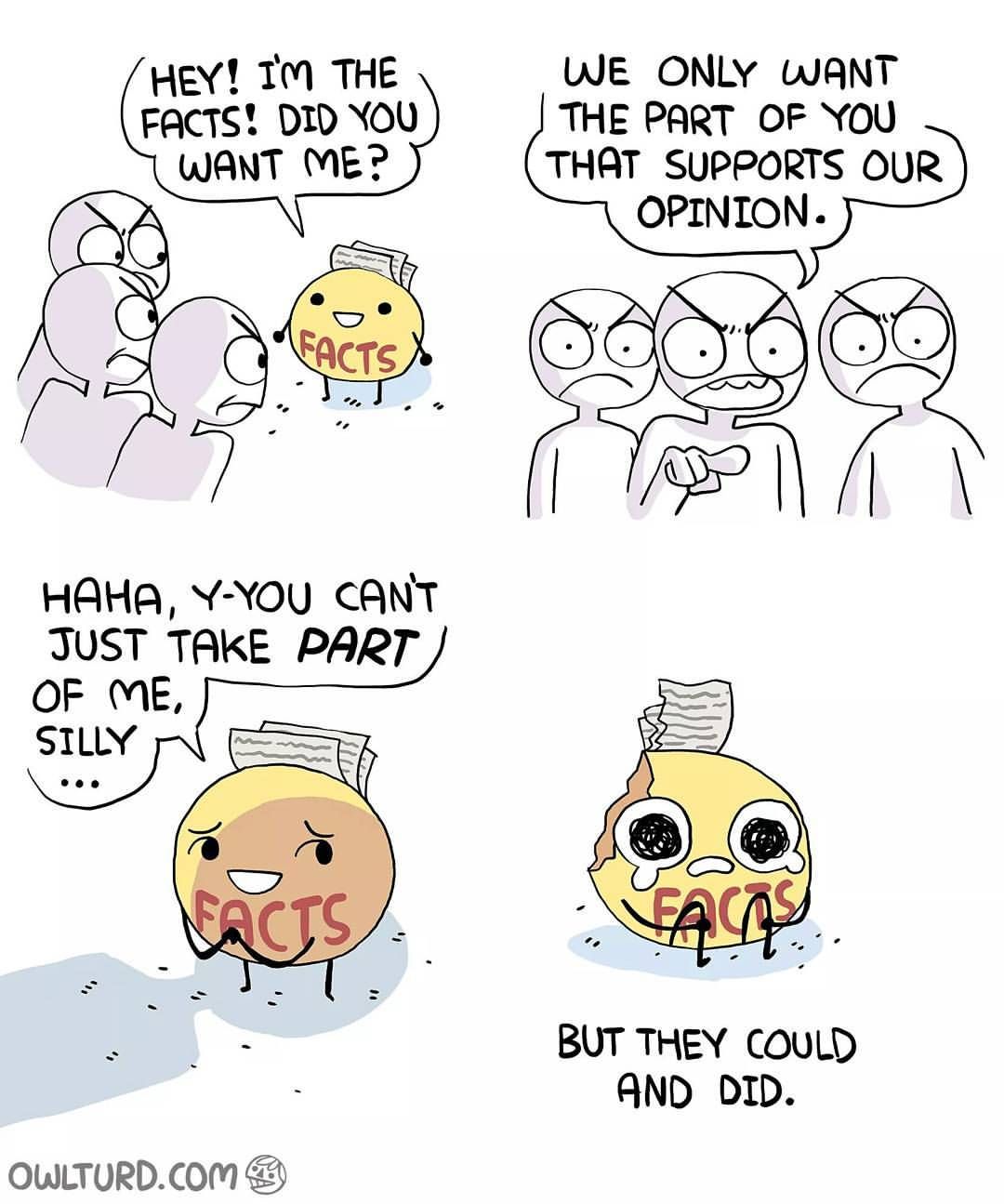

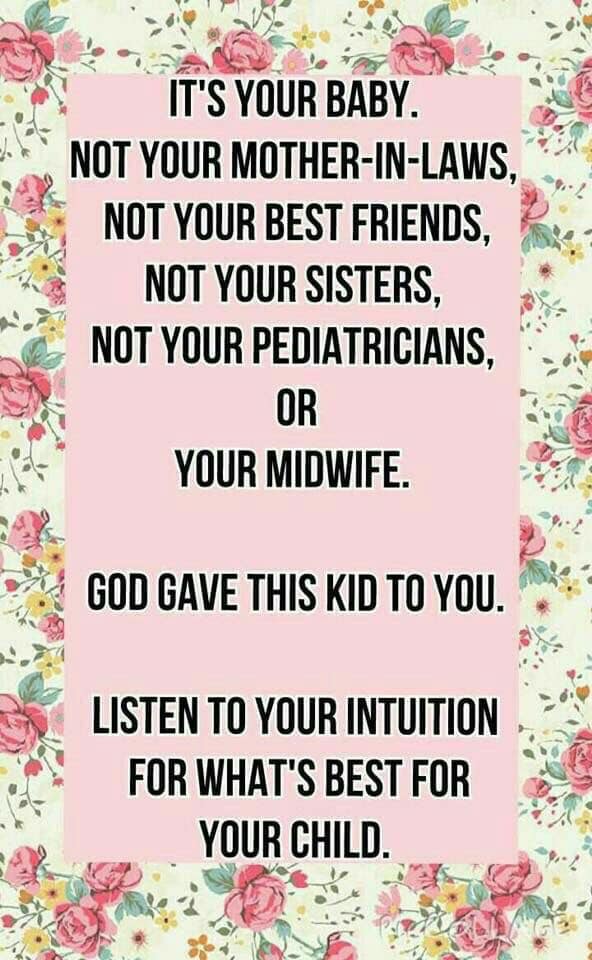


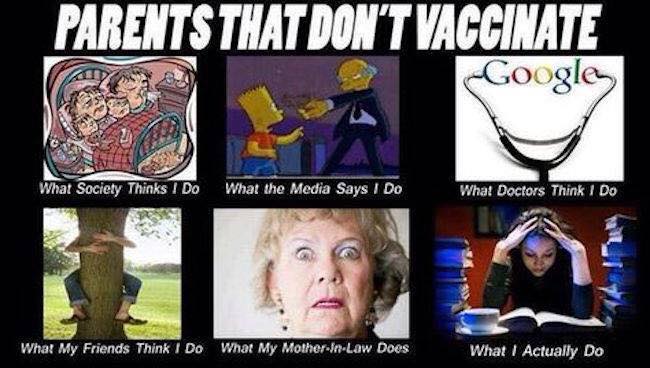
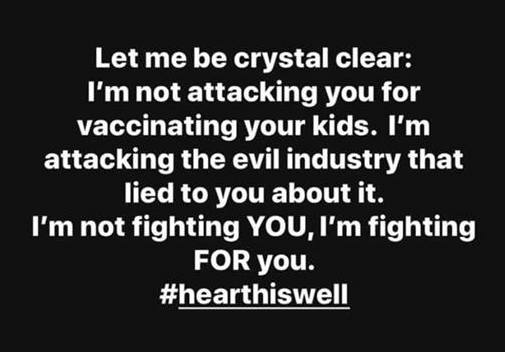







 Nathalie Van Raemdonck